DPF Regeneration Explained: Active, Passive and Forced
If you drive a modern diesel, your car relies on regeneration to keep its DPF working properly. Most owners only hear the word when something has gone wrong — but understanding how the process works makes it far easier to spot problems early and avoid expensive damage. This guide explains the three types of regeneration, why they fail, and what to do when they do.
In this guide
DPF light won’t clear after a long drive?
Free DPF diagnostics across the West Midlands — we identify the cause before recommending any work.
Why diesels need DPF regeneration
The diesel particulate filter sits in your exhaust system and traps soot before it leaves the tailpipe. It’s a fine ceramic honeycomb with channels narrow enough to catch tiny carbon particles. Without it, modern diesels couldn’t meet emissions regulations.
The challenge is that the filter has finite capacity. Every mile you drive, more soot collects in those channels. Left alone, the filter would block within weeks. Regeneration is the process that solves the problem — exhaust temperatures rise high enough to burn the trapped soot away, leaving only a small ash residue.
There are three different ways this can happen. Each has a role to play, and each fails in different ways. Knowing which is which helps you read what your car is doing and respond before a small issue becomes a major one.
Passive regeneration: what happens automatically
Passive regeneration is the version most diesel owners benefit from without ever realising it. It happens whenever exhaust temperatures naturally reach around 350 to 500 degrees Celsius for a sustained period — typically during longer motorway or dual carriageway drives.
At those temperatures, soot in the filter oxidises slowly and continuously. There’s no need for the ECU to do anything special. No warning lights, no extra fuel, no change to how the car drives. The filter simply clears itself in the background.
Passive regeneration is the most efficient form. It costs no extra fuel and creates no additional engine wear. The cars that have the fewest DPF problems tend to be those used on longer trips where this kind of regen happens naturally throughout the week.
Why some drivers never get passive regen
If your driving is mainly short, urban, or stop-start, exhaust temperatures don’t get high enough for long enough. The school run, supermarket trips, and city commutes simply don’t generate the heat needed. Soot collects faster than passive regeneration can clear it, and the filter slowly loads up.
This is why diesel cars used predominantly for short trips tend to develop DPF problems within a few years, while cars on regular long journeys can run for ten years and 150,000 miles without an issue.
Active regeneration: what the ECU triggers
When the ECU detects that the soot loading has reached a threshold the filter can no longer manage through passive regeneration alone, it triggers an active regeneration cycle. This happens automatically and you may not always notice it.
During active regen, the ECU adjusts engine timing and injects a small post-combustion fuel charge into the exhaust stream. This raises exhaust temperatures to around 600 degrees Celsius — high enough to burn off accumulated soot in a controlled way over roughly 10 to 20 minutes.
Signs that an active regeneration is in progress include:
- Idle speed slightly raised when stopped
- Cooling fan running harder than usual
- A noticeable hot, slightly chemical smell from the exhaust
- Marginally higher fuel consumption for that journey
- Engine note slightly different from normal
None of these are causes for concern by themselves. Active regeneration is part of normal diesel operation. The problem only arises when the cycle can’t complete.
Important: If you suspect an active regeneration is in progress, don’t switch the engine off until you’ve finished your journey or driven for at least 15 to 20 minutes. Stopping mid-regen leaves the filter partially loaded with hot, semi-burned soot and forces the ECU to start over next time.
Forced regeneration: what we do at the workshop
If passive and active regeneration have both failed — usually because the soot loading has climbed past the level the ECU is willing to handle on its own — the only remaining options are forced regeneration or professional cleaning.
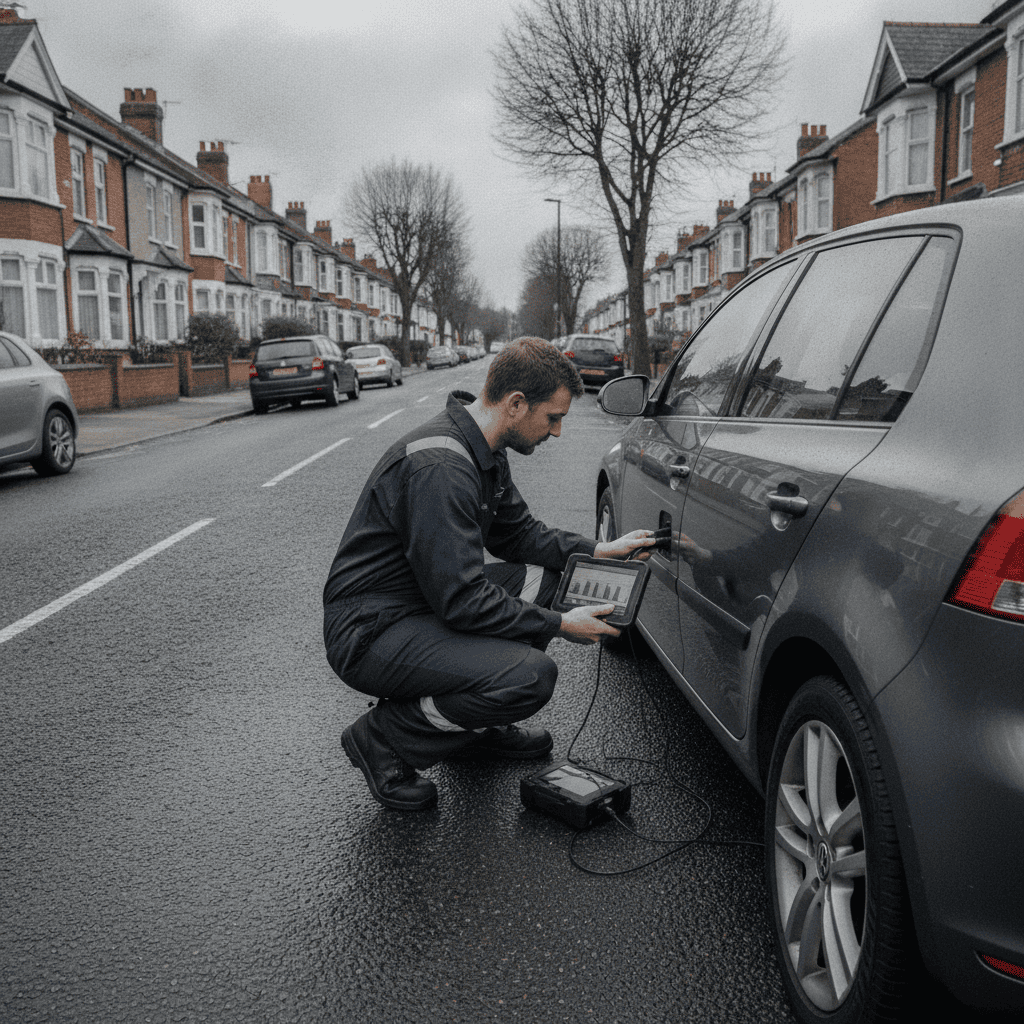
Forced regeneration is a workshop procedure. We connect diagnostic equipment to the vehicle, command the ECU into a controlled regen mode, and supervise the cycle as it runs. Exhaust temperatures climb to the same range as an active regen, but under controlled conditions — the engine is held at the correct RPM, oil temperature is monitored, and we can stop the procedure immediately if anything looks wrong.
Forced DPF regeneration works well when soot loading is moderate — typically below around 60 to 70 percent capacity. Above that, the filter usually needs professional cleaning before regeneration will succeed, because the soot loading is high enough that an attempted burn would either fail or risk damaging the substrate.
What forced regen can’t do
Forced regeneration burns soot. It doesn’t remove ash, the inert mineral residue that builds up over years of normal use. Once ash loading has reached a significant level, regeneration of any kind won’t restore filter capacity — only off-car deep cleaning will.
Forced regen also can’t fix a damaged substrate, a faulty differential pressure sensor, or an underlying engine issue causing excessive soot output. If those are present, the regen may complete but the filter will block again quickly afterwards.
Why regeneration fails
Regeneration is a controlled process, and like any controlled process it can be interrupted or prevented from completing. The most common reasons we see in the workshop are:
| Reason regen fails | What’s happening |
|---|---|
| Journeys too short | Active regen needs roughly 15 minutes of sustained driving above 40 mph to complete. Trips below that get interrupted. |
| Low fuel level | Many manufacturers prevent active regen below quarter tank to avoid running dry mid-cycle. |
| Faulty differential pressure sensor | If the ECU doesn’t trust its readings, it won’t initiate or won’t complete the regen. |
| EGR valve issues | A stuck or partially blocked EGR can affect combustion temperatures and prevent regen completion. |
| Engine fault stored | If another fault is logged in the ECU, regen is often blocked until the fault is cleared. |
| Oil dilution | If unburned fuel has entered the oil, the system disables regen to prevent further dilution. |
| Severe ash loading | Regen burns soot, not ash. Past a certain ash level, the filter can’t be restored by burning. |
Don’t ignore repeated regen attempts: If you notice the ECU triggering active regen frequently — multiple times a week — but the warning light keeps coming back, something is preventing the cycles from completing. Continuing to drive without resolving the cause increases the risk of oil dilution and turbo damage.
When professional help is the right step
If you’ve taken the car for a long drive and the DPF warning light hasn’t cleared, regeneration isn’t completing on its own. At that point, a diagnostic check is the practical next step — not just to read the fault codes, but to look at live differential pressure data and find out what the filter is actually doing.
From there, the right action depends on what we find:
- If soot loading is moderate and there are no underlying faults, forced regeneration usually clears the filter and resets the system.
- If soot loading is severe, or if regeneration has failed before, mobile DPF cleaning is the more reliable route. Mobile DPF cleaning brings the service to your home, work, or roadside location across the West Midlands.
- If the car is in limp mode and undriveable, an emergency DPF call-out avoids recovery costs and gets you back on the road.
The starting point in all cases is the same — free DPF diagnostics to confirm what the issue actually is. That avoids paying for a service you don’t need and makes sure the right fix is applied first time.
Regen not completing on your diesel?
We diagnose first, then advise — never the other way round. Mobile DPF service across Birmingham, Wolverhampton, Walsall, and the wider West Midlands.
Frequently asked questions
How long should a DPF regeneration take?
Active regeneration typically takes 10 to 20 minutes once it has started. Forced regeneration in the workshop runs for a similar duration but at controlled, observed conditions. If your car triggers an active regen and you stop after only a few minutes, the cycle won’t have completed.
Can I force my car to regenerate by driving it?
You can encourage active regeneration by sustained driving above 40 mph for at least 15 to 20 minutes. This works in the early stages when the warning light has just appeared. Once the loading is severe or limp mode has activated, driving alone won’t clear it.
How often should a DPF regenerate?
It varies with driving style. Cars used mainly on motorways may regenerate passively all day without ever triggering an active cycle. Urban-only cars may attempt active regen every few hundred miles. There’s no fixed interval — the ECU decides based on soot loading.
Does forced regeneration damage the engine?
When done correctly with diagnostic equipment and the filter is in suitable condition, forced regeneration is a controlled, low-risk procedure. The risks come from attempting it on a filter that’s already too heavily loaded, or without monitoring oil temperature and dilution levels.
What’s the difference between cleaning and regeneration?
Regeneration burns soot off using high temperatures inside the filter while it’s still on the car. Cleaning physically removes both soot and ash, usually with the filter removed and processed off-car. They solve different problems — regen handles soot, cleaning handles ash and severe soot loading together.