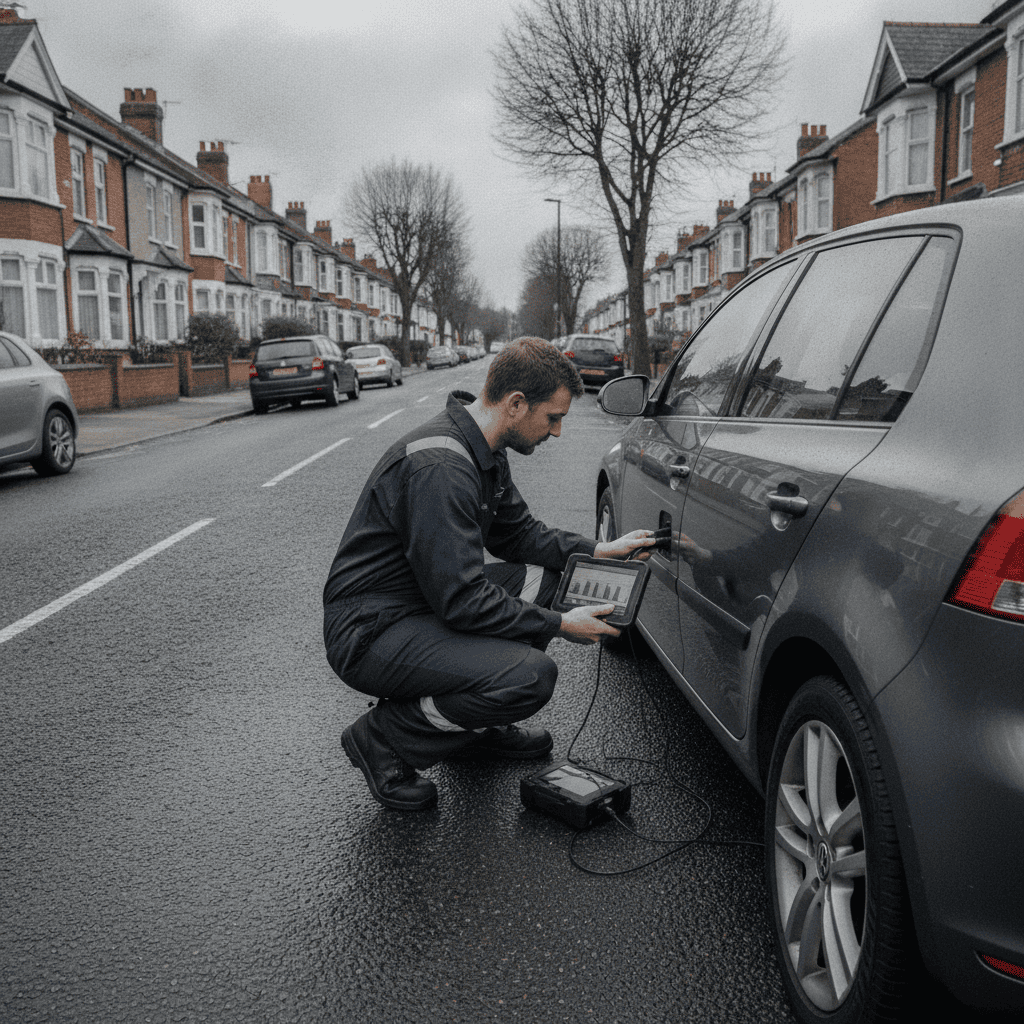
VW Transporter T6 DPF Cleaning West Midlands: Mobile Specialist for Your Van
DPF warning light on your T6? Stuck in limp mode? We come to you — no garage or tow truck needed.
Free diagnostics before any work begins. Same-day appointments available across the West Midlands.
The VW Transporter T6 is one of the most popular diesel vans on West Midlands roads. Builders, electricians, plumbers, and tradespeople rely on them daily — and that daily commercial use is precisely what drives DPF problems. Short runs between job sites, town-speed driving, and idling at the kerbside all prevent the filter from completing its normal self-cleaning cycle. Warning lights follow, then limp mode.
Most dealers quote a forced regeneration, a new filter, or both. In the majority of T6 DPF cases, the filter can be cleaned professionally without replacement. DPF Clean Specialist provides a fully mobile DPF service across the West Midlands — attending your yard, home, or workplace to diagnose and treat the fault without towing or waiting for a garage slot.
Quick answer: VW Transporter T6 DPF cleaning involves a diagnostic scan, forced regeneration, and specialist chemical treatment to clear accumulated soot and ash from the filter. A mobile specialist can attend your location across the West Midlands and resolve most T6 DPF faults on the same day, without DPF replacement or a dealership booking.
Why VW T6 Vans Are Prone to DPF Faults
The VW Transporter T6, launched in 2015 and updated as the T6.1 in 2019, uses a 2.0-litre TDI diesel engine across all variants — from the 84 PS entry model to the 204 PS DSG automatic. Every diesel T6 carries a diesel particulate filter as standard, fitted to meet Euro 5 and later Euro 6d emissions regulations.
The DPF is designed to clean itself through regeneration. Passive regeneration happens naturally on motorways and A-roads, where sustained exhaust temperatures above 600°C burn off accumulated soot. Active regeneration is triggered automatically by the ECU when passive regen hasn’t been sufficient — the engine increases exhaust temperature using post-injection fuel to force a burn-off cycle.
Trade van use breaks both of these processes. A tradesperson doing three jobs across Birmingham in a day rarely sustains the conditions needed for passive regen. Active regen needs 15–20 continuous minutes at speed to complete — stop-start town driving interrupts it mid-cycle, leaving partially burned soot that compounds over time. By the end of a working week, the filter has accumulated what a longer regen cycle might have prevented.
This isn’t a design flaw. The T6 DPF works correctly when driven on mixed routes. The issue is a mismatch between the demands of commercial van use and the conditions the filter needs to stay healthy — and it’s a pattern DPF specialists across the West Midlands see week after week.

Warning Signs to Watch for on a VW T6
T6 DPF faults develop in stages. Acting early costs less and takes less time to fix.
- Yellow DPF warning light: The first sign — the filter icon in the dashboard cluster. At this stage, a sustained 30-minute motorway or dual-carriageway run at 2,500–3,000 rpm may still clear the fault through passive regen. If the light remains after that run, the filter needs professional attention.
- Flashing glow plug light: The DPF is now severely blocked and the van has entered a protection state. Continued driving should be kept to the minimum needed to reach a safe stopping point.
- Engine management light alongside glow plug light: Fault codes are now stored. The most common code at this stage is P2458. The ECU has logged a failed regen cycle.
- Limp mode: The ECU cuts power dramatically — most T6 owners report being unable to exceed 15–20mph. This is a hard protection state designed to prevent engine damage.
- Increased fuel consumption: The engine is attempting repeated active regenerations with each warm-up, burning extra fuel each time without clearing the filter.
- White or grey smoke on startup: A sign the DPF is attempting a regen it cannot complete, or that oil dilution from excessive regeneration attempts has begun.
If the glow plug light is flashing or the van is in limp mode, it should not be driven further until a specialist can assess it. Continuing to drive with a severely blocked T6 DPF risks secondary damage to the EGR valve and turbocharger — faults that are significantly more expensive to repair. For background on how these systems interact, our guide to EGR valve faults and DPF symptoms covers the relationship in detail.
What Fault Code P2458 Means on a VW T6
P2458 is the fault code that appears most often in T6s with DPF problems. It stands for “DPF Regeneration Duration” — meaning the ECU triggered a regen cycle, but it took longer than the calibrated limit to complete, or failed to complete at all.
According to OBD reference data, P2458 is stored when the DPF regeneration process cannot sustain the exhaust temperatures required to burn off accumulated soot within the ECU’s expected time window. On the T6, this commonly happens because high soot loading from short-journey use combines with a blocked or faulty DPF differential pressure sensor line — preventing the ECU from getting accurate filter readings and triggering regen at the right time.
Additional fault codes commonly stored alongside P2458 on VW diesel engines include:
- P2002: DPF efficiency below threshold — the filter is passing exhaust gases without capturing particulates properly, often due to severe blockage or damage.
- P0490: EGR control circuit high — a secondary fault that frequently accompanies DPF problems when the EGR system is also affecting exhaust temperature management.
- P2463: DPF soot accumulation — the filter has exceeded its maximum soot loading and requires immediate intervention.
Fault codes give an indication of the problem but not the full picture. Proper diagnosis requires live data — actual back-pressure readings from the DPF pressure differential sensor, current soot mass calculations, and exhaust temperature history. A specialist who works from live data rather than codes alone gives you a much more accurate picture of what’s actually needed before any work begins.
Worth knowing: A significant proportion of T6 P2458 faults are caused by a blocked or disconnected DPF pressure sensor line rather than a fully clogged filter. Clearing the sensor line and running a forced regen resolves the issue completely. This is why diagnosis before any parts recommendation matters.

What Not to Do When Your VW T6 DPF Light Comes On
The instinct for van owners is to keep working and deal with warning lights later. With DPF faults, that tends to convert a straightforward clean into a much more expensive repair.
- Don’t ignore the warning and keep doing short runs: The filter accumulates more soot with every journey. Once it reaches critical loading, forced regeneration can no longer help and the filter may need removal and specialist off-van cleaning or replacement.
- Don’t consider DPF deletion: Removing a DPF is illegal under the Road Vehicles (Construction and Use) Regulations 1986. It’s a specific MOT failure point, and DVSA roadside enforcement checks vans for DPF presence — with fines of up to £2,500. Our guide to DPF delete versus professional cleaning explains why cleaning is the only viable legal path for trade vehicles.
- Don’t buy an additive and assume that’s sufficient: DPF additive products can support regeneration in mild early-stage cases but cannot clear a heavily loaded filter at the point where warning lights are active.
- Don’t drive extended distances in limp mode: The T6 in limp mode is protecting the engine by restricting power. Continued driving risks oil dilution from failed regeneration attempts, which can damage the turbocharger and require a significantly more expensive repair.
The most cost-effective response is early diagnosis. A mobile specialist attending your location can assess the fault for free and give an honest, evidence-based recommendation before any work is authorised.
What Mobile DPF Cleaning Involves for a VW T6
Our mobile DPF cleaning service attends your location anywhere in the West Midlands — your yard, home address, workplace car park, or a safe roadside location if the van isn’t driveable.
The service for a VW T6 follows a structured diagnostic and treatment sequence:
- OBD2 diagnostic scan: We connect to the T6’s OBDII port, read all stored fault codes, and pull live DPF data — soot mass, ash content, back-pressure readings, and regeneration history. This confirms whether the primary fault is the filter, the pressure sensor line, or an underlying EGR issue.
- Forced regeneration (where viable): If soot loading is within range for successful regen, we run a forced regeneration cycle using specialist diagnostic software. This takes 20–40 minutes and burns off soot under controlled, sustained conditions that road driving alone can’t replicate when the van is already symptomatic.
- Chemical DPF treatment (where required): For higher soot and ash accumulation, we apply a professional-grade DPF cleaning solution directly into the filter matrix. This breaks down compacted ash deposits that regeneration alone cannot remove.
- Post-treatment verification: Once the treatment cycle is complete, we clear stored fault codes and run the vehicle to confirm DPF back-pressure readings have returned to normal operating range and the ECU is no longer logging regen failures.
The majority of T6 DPF faults are resolved in a single visit. If the filter is genuinely beyond cleaning — typically when ash loading is severe and physical matrix damage is present — we’ll advise on the most cost-effective replacement route without recommending unnecessary parts. We also cover other diesel vans in the region: our guide to Ford Transit DPF cleaning in the West Midlands outlines the same mobile approach for Transit owners.
Cost: Mobile Specialist vs VW Dealership
The cost difference between a mobile independent specialist and a VW main dealer is significant — and the approach is different too.
| Service | Mobile Specialist | VW Dealership |
|---|---|---|
| Initial diagnostic check | Free | £90–£150 |
| Forced regeneration | Included in treatment | £150–£300 |
| Professional on-van DPF clean | £250–£400 typically | Rarely offered |
| DPF replacement (if genuinely required) | Referred out at cost | £800–£1,500+ |
| Callout to your location | Included | Not available |
Main dealers often default to DPF replacement rather than attempting professional cleaning, particularly on T6 models beyond three years old. An independent mobile specialist diagnoses first and only recommends what the vehicle’s live data actually indicates. For the majority of T6 DPF faults — particularly P2458 presentations without physical filter damage — professional cleaning resolves the fault at a fraction of replacement cost.
Areas We Cover in the West Midlands
We provide VW Transporter T6 DPF cleaning across the full West Midlands region, including Birmingham, Wolverhampton, Walsall, Dudley, Solihull, West Bromwich, Coventry, Sutton Coldfield, Tamworth, Lichfield, Cannock, Stourbridge, Kidderminster, Halesowen, Worcester, and the surrounding areas. Same-day and next-day bookings are available for urgent faults where the van cannot be driven.
Frequently Asked Questions
Can a VW T6 DPF warning light clear itself?
If the DPF light has appeared but the glow plug light isn’t flashing and the van isn’t in limp mode, a sustained 30-minute run on a dual carriageway or motorway at 2,500–3,000 rpm may allow passive regeneration to complete and the light to clear. If the light returns within a few days or the van is already in limp mode, the filter needs professional attention — it’s beyond self-clearing at that point.
Will a VW T6 DPF fault cause an MOT failure?
Yes. A DPF that has been removed or bypassed is an automatic MOT failure. A DPF causing an active engine management light will also typically result in failure via the EML check. A filter with elevated soot levels that isn’t triggering active warning lights may pass the visual inspection but may attract advisories from a thorough tester.
How often does a VW Transporter T6 DPF need professional cleaning?
Under typical mixed-use driving with regular A-road or motorway sections, the T6 DPF should manage itself through passive regeneration indefinitely. Vans used primarily on short commercial runs may need professional cleaning every 2–4 years depending on mileage. Once the first professional clean has been carried out, extending journey distances where possible reduces the frequency of future blockages.
What is the P2458 fault code on a VW Transporter T6?
P2458 is the “DPF Regeneration Duration” code — the ECU triggered a regen cycle but it couldn’t complete within the calibrated time window. It’s the most frequently stored T6 DPF fault code and indicates either high soot loading, a blocked pressure sensor line, or an underlying issue preventing the engine from reaching and sustaining regen temperature.
Is DPF removal an option for a VW T6 van?
No. DPF removal is illegal for any diesel vehicle used on public roads under the Road Vehicles (Construction and Use) Regulations 1986. For commercial vans, DVSA on-road enforcement checks include DPF inspection, with fines of up to £2,500. Professional cleaning is the only legal and practical solution for a blocked T6 DPF.
VW Transporter T6 DPF Specialist — West Midlands Mobile Service
We attend at your location, run a free diagnostic, and only carry out work your T6 actually needs. Same-day bookings available for urgent faults across the region.
Published: 8 September 2026 · By DPF Clean Specialist Team