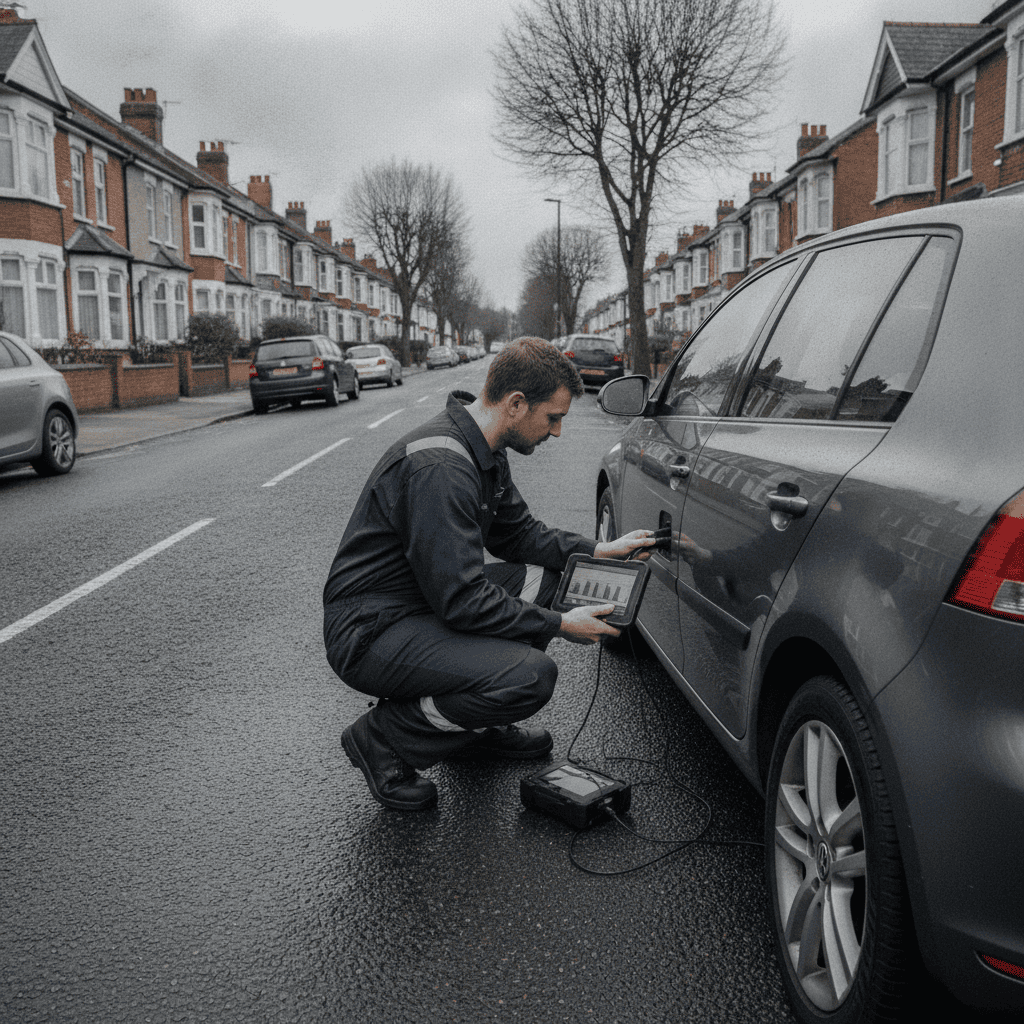
Commercial vehicles develop DPF problems at a higher rate than private cars — and the consequences are more disruptive. A van or light commercial off the road isn’t just an inconvenience; it’s lost revenue, missed jobs, and schedule pressure. This guide explains why fleet vehicles are more vulnerable, what the most common fault patterns look like, and how to manage DPF issues with minimal downtime.
In this guide
- Why commercial vehicles get more DPF problems
- How duty cycle prevents regeneration completing
- Common DPF fault patterns in fleet vehicles
- Warning signs fleet drivers and managers should know
- The real cost of ignored DPF faults across a fleet
- Minimising downtime: on-site mobile DPF service
- Proactive management vs. reactive repairs
- Frequently asked questions
Fleet DPF support across the West Midlands
Mobile diagnostics and DPF cleaning at your depot, site, or roadside location. Minimise vehicle downtime with on-site service.
Why commercial vehicles get more DPF problems
The diesel particulate filter relies on heat to stay clean. During regeneration, exhaust temperatures need to reach a sustained threshold — typically 550°C or above — for long enough to burn off accumulated soot. In private cars, a motorway journey or an extended run on a dual carriageway often triggers this naturally. In commercial vehicles, the working environment rarely provides the same opportunity.
Delivery vans, trade vehicles, local authority fleet, and site support vehicles are typically driven on routes that consist almost entirely of short hops, frequent stops, and urban traffic. The engine is rarely asked to maintain the sustained load and speed needed for passive regeneration to complete. Soot accumulates faster than the filter can clear it, and the problem compounds with every short journey. Taxi and private hire vehicles face this problem in its most acute form — see our guide to taxi and private hire DPF problems for how the PHV duty cycle creates one of the most demanding DPF environments of any vehicle type.
Add to this the fact that commercial vehicles are typically working harder than private cars — heavier loads, more frequent cold starts, higher annual mileage — and the DPF is under greater overall stress. A vehicle that covers 30,000 miles a year in urban delivery use will load its DPF far faster than a private car covering the same annual distance on varied routes.
How duty cycle prevents regeneration completing
Regeneration requires a specific combination of engine temperature, exhaust temperature, and operating duration. The vehicle’s ECU manages this — it monitors DPF loading via the differential pressure sensor and triggers active regeneration when loading reaches a defined threshold, provided the operating conditions are suitable.
The problem for commercial vehicles is that active regeneration attempts are frequently interrupted. A driver completing deliveries switches the engine off before the regen cycle has finished. The van starts up again 20 minutes later for the next drop. The interrupted regen leaves partially processed soot in the filter; the next attempt starts from a higher base loading than before. Over multiple interrupted cycles, the loading climbs to a level where the ECU can no longer trigger a successful regen at all.
This pattern — repeated partial regeneration attempts, none completing — is one of the most common routes to a blocked DPF in commercial vehicles. It doesn’t reflect a fault with the vehicle; it’s a natural result of the work the vehicle is being asked to do. Understanding this is important because it means prevention and early intervention are more valuable than waiting for the warning light to appear.
Common DPF fault patterns in fleet vehicles
Fleet operators encounter a recognisable set of DPF fault patterns across their vehicles. Knowing what these look like helps managers identify problems earlier and respond more efficiently.
Progressive soot accumulation
The most common pattern is gradual. The filter loads steadily over weeks or months of urban use, regen attempts fail to complete, and the ECU eventually reaches a point where it flags a fault. By the time the warning light appears, the filter is often already significantly loaded — which is why catching the pattern earlier, before the warning appears, is more effective than waiting for it.
Oil dilution from failed regen attempts
When regeneration is repeatedly attempted but fails to complete, the fuel injected to raise exhaust temperatures during the regen cycle can pass the piston rings and contaminate the engine oil. Oil dilution reduces lubricating effectiveness and, if not caught, can lead to accelerated engine wear. Fleet vehicles that are used on predominantly short urban routes are particularly susceptible to this, since the oil doesn’t get hot enough for long enough to evaporate out any fuel contamination naturally.
Signs of oil dilution include an unexpectedly rising oil level on the dipstick or oil that smells of diesel. Neither should be ignored, and both point to a need for DPF intervention before the engine itself is affected.
Accelerated ash loading
Unlike soot, ash doesn’t burn off during regeneration. It accumulates permanently as a byproduct of engine oil combustion products passing through the filter. High-mileage commercial vehicles — particularly those covering significant annual mileage — reach the point of ash-related restriction sooner than private cars. When ash loading becomes significant, the filter’s capacity is reduced and it will block on less soot than it previously could hold.
Sensor and pipe issues at higher mileage
Fleet vehicles often cover significantly higher annual mileages than private cars. The differential pressure sensor and the associated pressure pipes that feed it are exposed to constant heat and vibration. Over time, pressure pipes can partially block with condensation and soot, and sensor calibration can drift. Both cause inaccurate DPF system readings and can trigger fault codes or incorrect regeneration behaviour without the filter itself being the problem.
Warning signs fleet drivers and managers should know
Fleet drivers are the first line of awareness. Equipping them to recognise early DPF warning signs means problems can be reported before they escalate.
| Warning sign | What it likely indicates | Action |
|---|---|---|
| DPF warning light on dashboard | Filter loading has reached the point where action is needed | Report immediately; avoid switching engine off unnecessarily |
| Engine management light | DPF-related fault code or another emissions system fault | Get a diagnostic read to identify the specific code |
| Noticeable drop in power | Early limp mode or back pressure affecting performance | Report and get diagnostic assessment |
| Oil level rising on dipstick | Fuel contamination of engine oil from failed regen | Urgent — stop extended driving, get assessment same day |
| Fuel consumption increasing without explanation | ECU triggering more frequent regen attempts | Note and report; get DPF loading checked |
| Strong exhaust smell during or after driving | Active regen cycle running; normal unless prolonged | Note if persistent without warning light clearing |
Important for fleet managers: Limp mode in a commercial vehicle means the driver is already in a degraded operating state. A van in limp mode should not be sent out on further deliveries. The additional running in a restricted state risks secondary damage — particularly to the turbo — and doesn’t allow the fault to resolve on its own. Get a same-day diagnostic assessment.
The real cost of ignored DPF faults across a fleet
A single DPF fault that develops without intervention carries a chain of costs: the vehicle off the road while it’s investigated, the diagnostic and repair cost, potential secondary damage costs if the fault has been allowed to develop, and the administrative overhead of managing the whole incident.
Across a fleet, the cumulative effect is significant. If three vehicles in a 15-vehicle fleet develop DPF faults in the same quarter, each requiring a day off the road for diagnosis and repair, the total disruption is measurable. If any of those faults have progressed to the point of oil dilution or turbo damage, the cost increases substantially — turbo replacement on a commercial diesel can reach into the thousands.
The cost comparison between catching a DPF fault early (a forced regen or straightforward mobile clean) and catching it late (professional cleaning plus potential secondary damage repair plus extended downtime) is stark. This is the business case for proactive management rather than reactive response.
Minimising downtime: on-site mobile DPF service
One of the most effective ways to reduce the disruption from DPF faults in a fleet context is mobile servicing — where the diagnostic equipment and cleaning capability comes to the vehicle rather than the vehicle going to a workshop.
For a fleet depot or yard, mobile DPF service means vehicles can be assessed and treated on-site without the scheduling overhead of booking garage slots or arranging vehicle recovery. Multiple vehicles can be addressed in a single visit where the fault pattern indicates a common issue. The vehicle is available again as soon as the work is complete, without the transit time to and from a fixed workshop.
Commercial fleet DPF services at DPF Clean Specialist include mobile diagnostics and cleaning at your site across the West Midlands. For urgent situations — a vehicle in limp mode that needs same-day attention — emergency call-out is available to minimise the time a vehicle is off the road.
Proactive management vs. reactive repairs
For fleets operating diesel vehicles on predominantly urban routes, a degree of DPF maintenance is predictable rather than unexpected. The question is whether it’s managed proactively — at lower cost, with minimal disruption — or reactively, when the fault has already impacted operations.
A practical proactive approach includes a few straightforward elements:
- Driver awareness: Drivers report DPF warning lights and unusual symptoms immediately rather than continuing their route and hoping it clears. Early reporting is the single most effective intervention.
- Scheduled DPF checks: For vehicles on known high-risk routes — short urban delivery runs, stop-start urban work — periodic diagnostic checks can identify a filter approaching a problematic loading level before the warning light appears.
- Oil change intervals: Vehicles on routes prone to incomplete regeneration may benefit from more frequent oil changes to manage the cumulative risk of oil dilution.
- Route awareness: Where possible, ensuring fleet vehicles complete at least some sustained higher-speed driving regularly helps the filter manage its own regeneration. This isn’t always possible depending on the work, but it’s worth considering for scheduling.
Good to know: Mobile DPF diagnostics can be arranged to check multiple fleet vehicles in a single site visit. This is an efficient way to assess the DPF status across a fleet without taking each vehicle out of service for a workshop appointment. Contact DPF Clean Specialist to discuss a fleet assessment arrangement.
Keep your fleet on the road with on-site DPF support
Mobile diagnostics and DPF cleaning at your depot or site. West Midlands fleet coverage including Birmingham, Wolverhampton, Walsall, Lichfield and surrounding areas.
Frequently asked questions
How often should fleet vehicles have their DPF checked?
For vehicles on predominantly urban routes with short journeys, a DPF check every 6 to 12 months is a reasonable interval — particularly for higher-mileage vehicles or those that have had DPF faults before. Vehicles on mixed or motorway-heavy routes may manage longer between checks. The right interval depends on the specific duty cycle and vehicle history.
Can DPF problems be prevented entirely on urban fleet vehicles?
Not entirely, but the frequency and severity of problems can be managed significantly. Driver awareness, prompt reporting, oil change intervals that account for the duty cycle, and periodic DPF checks all reduce the likelihood of a fault developing into a major disruption. Some level of DPF maintenance should be expected as part of operating diesel vehicles on short urban routes.
What’s the difference between fleet DPF service and a standard DPF clean?
The cleaning process itself is the same. Fleet service typically includes the ability to attend a depot or yard and deal with multiple vehicles in a single visit, scheduling that works around operational needs, and an understanding of the common fault patterns that affect commercial vehicles specifically. The diagnostic and cleaning approach is tailored to the vehicle type rather than applying a one-size approach.
If one van in a fleet develops a DPF fault, should the others be checked?
It depends on whether the vehicles share a similar duty cycle. If multiple vans are doing the same type of route — short urban deliveries, stop-start urban work — and one develops a DPF fault, others on the same route may be approaching a similar loading level. A diagnostic check across the fleet can confirm loading status across vehicles and identify any that are heading toward a problem before the warning light appears.
Is mobile DPF service available for larger commercial vehicles?
Contact DPF Clean Specialist to discuss the specific vehicles in your fleet. Mobile service capabilities vary depending on vehicle type and the complexity of the DPF system. For an accurate picture of what can be supported at your site, a direct conversation is the most efficient route.
Further reading: plant and agricultural DPF cleaning — why site machinery blocks faster