DPF Clean Specialist — West Midlands
DPF Differential Pressure Readings Explained
Understanding your DPF pressure readings can tell you a lot about the health of your filter — and help you decide whether you need professional attention before a small issue becomes expensive.
If you have access to an OBD reader or live diagnostic data, your DPF differential pressure readings are one of the most useful numbers you can monitor. They give a direct window into how your diesel particulate filter is performing — and how loaded it currently is.
The problem is that many drivers have access to this data but are not sure what it means. What is a normal DPF pressure reading? What does a high pressure figure actually tell you? When does the reading suggest you need to act?
This guide explains DPF pressure readings in plain English, covering what the numbers mean at idle and at higher revs, what the normal ranges look like, and when an unusual reading should prompt you to get a specialist involved.
In This Guide
- What DPF differential pressure actually measures
- Normal DPF pressure readings: idle and 2500 rpm
- What high DPF back pressure means
- What low or zero DPF pressure means
- Why the trend matters as much as the number
- DPF pressure sensor fault vs actual blockage
- When to get professional DPF diagnostics
- FAQs
What DPF Differential Pressure Actually Measures
Your diesel particulate filter sits in the exhaust system and traps soot particles from the engine. Over time, those particles accumulate and restrict the flow of exhaust gases through the filter.
A differential pressure sensor measures the pressure difference between the inlet and outlet of the DPF. When the filter is clean, exhaust gas flows through relatively freely and the pressure difference is low. As the filter fills with soot, it becomes harder for gas to pass through, and the pressure difference increases.
In short: a rising differential pressure reading typically means your DPF is becoming more loaded with soot. A reading that stays consistently high — even after a regeneration cycle — suggests the filter may not be cleaning itself properly.
Key point: DPF differential pressure is measured in millibar (mbar). The sensor reports real-time data that your engine management system uses to decide when to trigger a regeneration cycle.
The Two Measurement Points That Matter
The most useful DPF pressure readings come from two engine speeds:
- At idle: Low-load measurement that gives a baseline when the engine is relaxed and exhaust flow is minimal.
- At 2500 rpm: Higher exhaust flow rate that gives a more reliable indication of actual filter restriction.
The 2500 rpm reading is particularly useful because it amplifies the pressure difference — making it easier to spot a problem. A slightly restricted filter that shows a modest reading at idle may show a much more significant reading at 2500 rpm.
Normal DPF Pressure Readings: Idle and 2500 RPM
Normal DPF differential pressure values vary between vehicle makes and engine types, so there is no single universal number. However, general guidance used by diesel technicians gives a useful reference point for most common diesel passenger vehicles.
| Engine Speed | Typical Range (Clean DPF) | Possible Concern | Likely Problem |
|---|---|---|---|
| Idle (~750–900 rpm) | 2–8 mbar | 10–15 mbar | 15+ mbar |
| 2500 rpm | 10–25 mbar | 30–50 mbar | 50+ mbar |
These are typical reference figures. Some vehicles — particularly larger engines or higher-displacement diesels — may have different baselines. A specialist with experience of your specific vehicle will be able to interpret readings in context.
The 2500 rpm test is key. Most experienced diesel technicians rev the engine to around 2500 rpm and hold it for a few seconds to get a stable, reliable differential pressure reading. A reading above 50 mbar at this engine speed in a standard passenger diesel is generally considered a strong indicator of significant soot loading or a blocked filter.
How Readings Change During a Regeneration Cycle
During an active regeneration, the engine management system increases exhaust temperature to burn off accumulated soot. If regeneration is working correctly, you should see DPF differential pressure readings drop back toward the clean range after a complete cycle.
If readings remain elevated after what should have been a successful regeneration, this is a strong indicator that the filter is partially blocked with ash — which cannot be burned off through regeneration alone and requires specialist cleaning.
What High DPF Back Pressure Means
A consistently high DPF back pressure reading tells you the filter is struggling to pass exhaust gases through. This restriction has knock-on effects throughout the engine.
Symptoms Associated with High DPF Back Pressure
- Loss of engine power or performance — particularly under acceleration
- Increased fuel consumption — the engine works harder to push gases through a restricted filter
- Limp mode activation — the engine management system limits power to protect itself
- DPF warning light on the dashboard
- Increased turbo noise or whistling in some cases
- Black smoke from the exhaust when the filter overflows
High back pressure does not always mean an immediate breakdown is imminent. But leaving it unaddressed typically leads to progressive worsening. The longer the filter remains significantly loaded, the harder it becomes to restore through standard cleaning.
Why Forced Regeneration May Not Be Enough
If DPF back pressure has been high for a prolonged period, or if the filter has been subject to multiple failed regeneration attempts, a simple forced regeneration may not resolve the problem. The soot loading may have partially converted to hard ash deposits that cannot be burned away.
In these cases, an off-car professional DPF clean or forced regeneration with diagnostics will typically be needed to confirm the state of the filter and decide the best course of action.
What Low or Zero DPF Pressure Means
An unexpectedly low or zero DPF differential pressure reading is also worth investigating — and not always for a good reason.
Possible Causes of a Very Low DPF Pressure Reading
- A recently cleaned or recently regenerated filter: A clean DPF will naturally show low readings. This is the normal state.
- A failed pressure sensor: If the sensor itself is faulty or disconnected, it may report zero or a flat reading regardless of actual filter condition.
- A damaged DPF substrate: In rare cases, a cracked or damaged filter allows gases to pass through with very little restriction — but this also means the filter is no longer capturing soot effectively.
- A removed or bypassed DPF: Illegally removed or bypassed filters obviously cannot create a meaningful pressure reading.
Zero pressure is not automatically good news. If your vehicle has a DPF fault code alongside a zero pressure reading, the most likely explanation is a faulty sensor rather than a perfectly clean filter. A diagnostic check is the fastest way to confirm which is the case.
Why the Trend Matters as Much as the Number
A single DPF pressure reading tells you where the filter is right now. But the trend over time tells you whether the situation is stable, improving, or deteriorating.
If your DPF pressure readings are gradually creeping up over weeks or months, it suggests the filter is accumulating soot faster than it can clear it through passive or active regeneration. This is common in vehicles that spend most of their time on short urban journeys — the engine rarely gets hot enough or runs long enough to complete a full regeneration cycle.
Tracking your DPF pressure readings periodically — especially if you have noticed any performance changes — gives you and your technician useful context. A reading of 45 mbar at 2500 rpm might be less concerning if it has been stable for three months than if it has doubled in the last four weeks.
Short Journeys and DPF Pressure Creep
Drivers who predominantly use their diesel for school runs, commutes of under five miles, or regular stop-start town driving are far more likely to see DPF pressure readings rise steadily. The regeneration cycle — which typically requires motorway or faster A-road driving for fifteen or more minutes — simply does not get triggered often enough to keep up with soot loading.
If this describes your driving profile and you are seeing higher DPF pressure readings, a longer motorway run may temporarily help. If the readings do not improve after a sustained motorway drive, the filter likely needs professional attention.
DPF Pressure Sensor Fault vs Actual Filter Blockage
One of the most common diagnostic challenges is separating a pressure sensor fault from an actual DPF blockage. The two conditions can produce similar fault codes and similar symptoms, but require very different responses.
| Condition | Pressure Reading | Typical Fault Code | Action Needed |
|---|---|---|---|
| Soot-blocked DPF | High (50+ mbar at 2500 rpm) | P2002, P244A | Forced regen or professional clean |
| Ash-loaded DPF | High — does not reduce after regen | P2002, P244A | Off-car professional DPF cleaning |
| Faulty pressure sensor | Zero, erratic, or implausible | P2452, P2453, P2454 | Sensor replacement |
| Blocked sensor pipe | Flat / no variance with revs | P2452, P2453 | Pipe clean or replacement |
Misdiagnosing a faulty sensor as a blocked filter leads to unnecessary cleaning costs. Misdiagnosing a blocked filter as a sensor fault leads to progressive damage. A proper diagnostic check using live data is the only reliable way to confirm which problem you are dealing with.
The free DPF diagnostics offered by DPF Clean Specialist includes a live data check of differential pressure readings before any work is recommended — so you know exactly what the issue is before you commit to a solution.
When to Get Professional DPF Diagnostics
You do not need to wait for a warning light to get your DPF pressure readings checked professionally. In many cases, acting earlier — when readings are elevated but not yet critical — makes the difference between a straightforward cleaning job and a more complex intervention.
Signs That Warrant a Diagnostic Check
- DPF pressure readings consistently above 40–50 mbar at 2500 rpm
- Readings that are rising steadily over several weeks
- Pressure readings that remain high after a motorway drive or forced regeneration
- Any DPF-related fault code alongside unusual pressure data
- Performance issues — reduced power, higher fuel consumption, or limp mode — even without a warning light
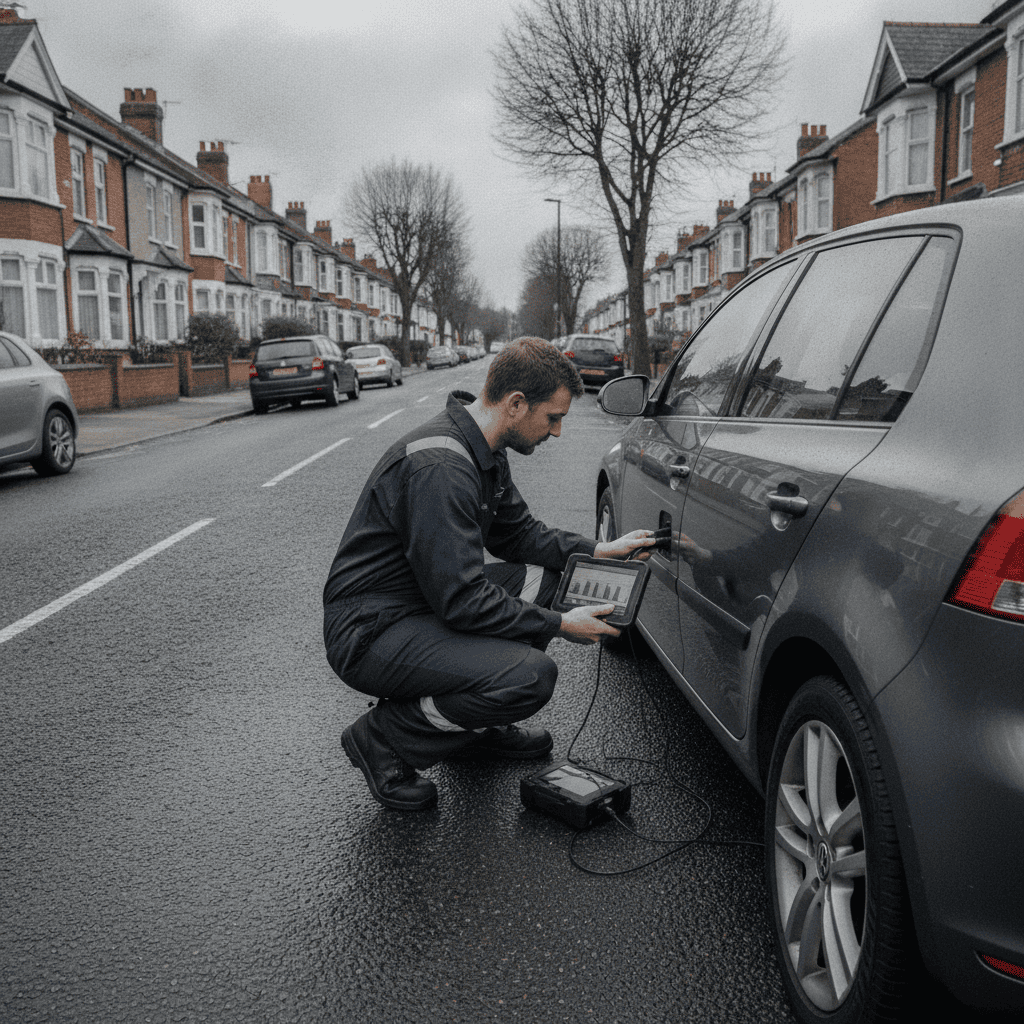
DPF Clean Specialist provides mobile DPF diagnostics across the West Midlands, attending your home, workplace, or roadside location. Live differential pressure data is checked as part of every diagnostic visit, giving a clear picture of filter health before any cleaning or regeneration work is recommended.
Over 10 years of diesel diagnostics experience, free diagnostics before any work begins, and transparent pricing mean you know exactly what you are dealing with before spending any money.
Not Sure What Your DPF Readings Mean?
Our mobile diagnostics service covers the West Midlands. We check live differential pressure data at your location — free of charge — before recommending any work.
Frequently Asked Questions
What is a normal DPF differential pressure reading at idle?
For most common diesel passenger vehicles, a healthy DPF at idle will show a differential pressure reading of around 2–8 mbar. Readings above 15 mbar at idle on a standard diesel suggest the filter may be significantly loaded with soot or ash.
What should DPF pressure read at 2500 rpm?
A clean DPF typically reads 10–25 mbar at 2500 rpm in a standard diesel passenger vehicle. Readings above 50 mbar at this engine speed are generally considered a strong indicator of a significantly blocked or restricted filter that needs attention.
Why is my DPF pressure reading zero?
A zero DPF pressure reading most commonly indicates a faulty or disconnected differential pressure sensor rather than a perfectly clean filter — especially if it is accompanied by a fault code. A proper diagnostic check using live data is the best way to confirm the cause.
Can I check DPF pressure readings myself?
Yes, if you have an OBD2 reader that supports live data (often called PIDs or live parameters), you can monitor DPF differential pressure in real time. However, interpreting the data correctly — especially distinguishing a sensor fault from an actual blockage — is best done by a specialist with the right diagnostic tools and experience.
Will a forced regeneration fix high DPF back pressure?
A forced regeneration can resolve high back pressure caused by soot loading, provided the filter is not excessively blocked. It will not clear ash deposits, which accumulate over a longer period and require professional off-car cleaning to remove.
We provide mobile DPF cleaning across the West Midlands, including Walsall, Tamworth, Cannock and Wolverhampton — book a free diagnostic and we’ll come to you.