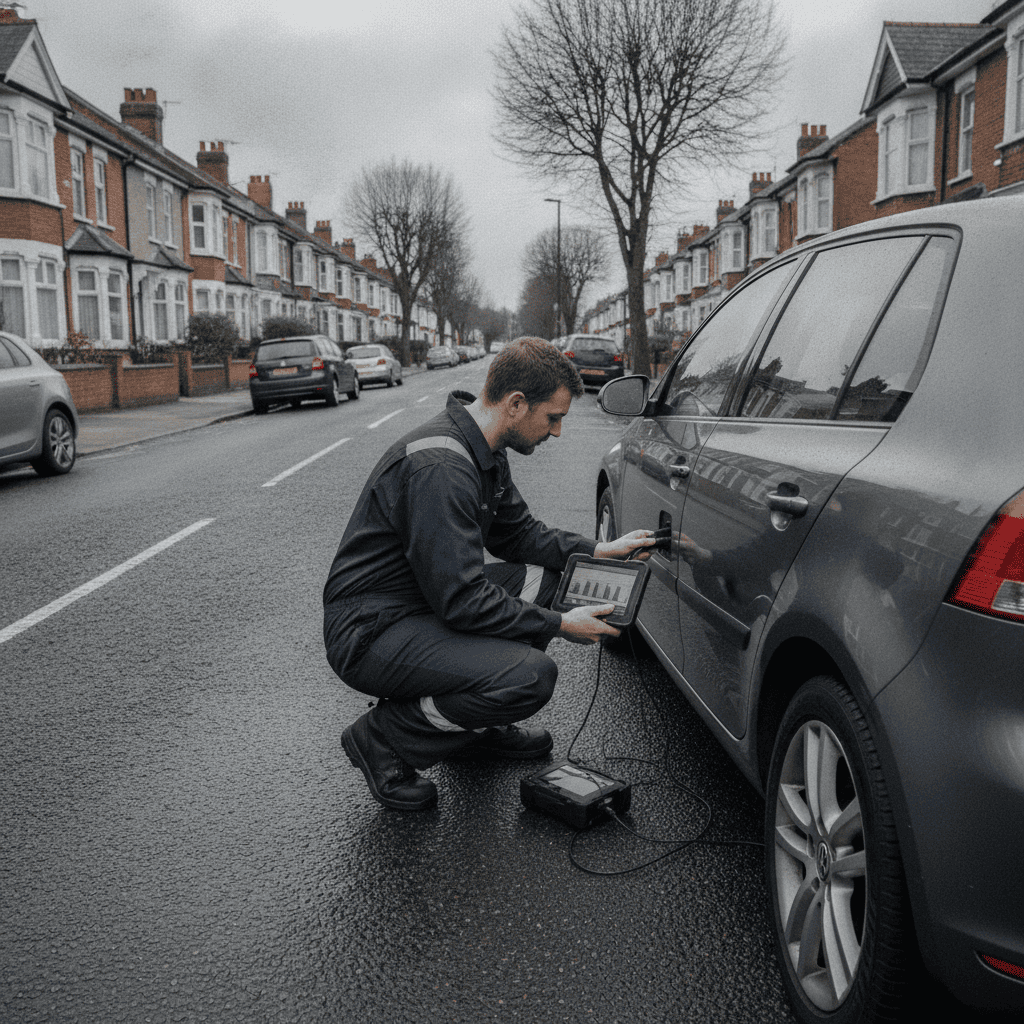
When a diesel car develops a blocked DPF, the driver notices quickly — warning lights, limp mode, loss of power. On a building site or in a field, the signs are often ignored for longer. A tractor that is a little sluggish gets pushed through harvest. A digger running rough on a busy contract gets kept moving until the day it does not start. By that point, the DPF is often beyond a straightforward clean — and the machine is off-road at the worst possible moment.
In this article
Which machines need DPF cleaning?
Any modern off-road diesel machine built to meet Stage IIIB or later emissions standards — broadly from 2011 for larger engines, 2013 for smaller ones — is likely to be DPF-equipped. In practice, that covers most plant and agricultural machinery currently in active UK use. Common equipment types include:
- Agricultural: Tractors, combine harvesters, telehandlers, self-propelled sprayers, balers and bale wrappers
- Construction: Excavators and diggers, skid steer loaders, rollers and compactors, bulldozers, telescopic handlers
- Utility: Forklifts, road sweepers, mobile generators, mobile compressors, airport ground support equipment
The manufacturers are familiar — John Deere, Kubota, JCB, Caterpillar, Komatsu, Case, New Holland, Manitou — and virtually all have moved to DPF-fitted engines across their Stage IV and Stage V compliant models. If your machine has a diesel engine made after 2011 and displays a particulate filter warning, it has a DPF.
Not sure if your machine has a DPF? Check the engine rating sticker or operators manual for the emission stage. Stage IIIB, Stage IV or Stage V all include DPF systems. Stage IIIA and earlier generally do not.
Why plant and agricultural DPFs block faster than road vehicles
No motorway driving, no passive regeneration
A road vehicle DPF relies partly on passive regeneration — sustained motorway driving at temperature causes soot to burn off naturally, without any driver input. Plant and agricultural machinery never experiences this. A tractor works fields at 10–15 mph. A digger idles between lifts. A roller makes short back-and-forth passes at walking pace. None of these operating cycles generate the exhaust temperatures — 550–600°C sustained for a meaningful period — required for passive regeneration.
The result is that soot accumulates steadily from day one, with no natural clearing cycle. Machines that rely on forced regeneration (an automated high-temperature burn cycle triggered by the ECU) can manage this, but only if those cycles are allowed to complete. On a construction site or in a field, the operator often shuts the machine down mid-cycle — which leaves the DPF in a worse state than before regeneration began.
Idling and variable loads: the other problem
Extended idling is the other major factor. Machines that idle while waiting — between lifts, at the end of a row, during breaks — run at very low exhaust temperatures. This is the worst possible condition for a DPF: the engine is producing soot, but the filter is too cool to deal with it. Agricultural machines are particularly prone to this during harvest, when downtime between field operations involves long idle periods at tick-over.
Variable load cycles compound the issue. A vehicle that accelerates steadily onto a motorway loads the DPF at a consistent rate the engine management system was designed for. A digger that cycles between full-power lifting and idle creates an unpredictable load pattern the regeneration system often cannot track efficiently.
For a broader overview of how DPF problems develop in commercial and fleet contexts, our guide to commercial vehicle DPF problems covers the common failure patterns that also apply to off-road equipment.
Signs your plant machinery DPF needs attention
The warning signs on plant and agricultural machinery are broadly the same as on road vehicles, though they are sometimes subtler in the early stages and harder to act on when the machine is in the middle of a job:
- DPF or filter warning light — usually amber in the first instance, escalating to red if ignored
- Engine derate or power reduction — the ECU limits output to protect the engine, noticeable as sluggishness under load
- Incomplete forced regeneration cycles — the dashboard may show a regeneration in progress that never clears
- Increased fuel consumption — a loaded DPF increases exhaust back pressure and forces the engine to work harder
- Excessive black smoke on startup — unburnt soot being expelled at ignition
- Machine entering limp mode — on more modern machines, severe DPF restriction triggers a protected operating mode
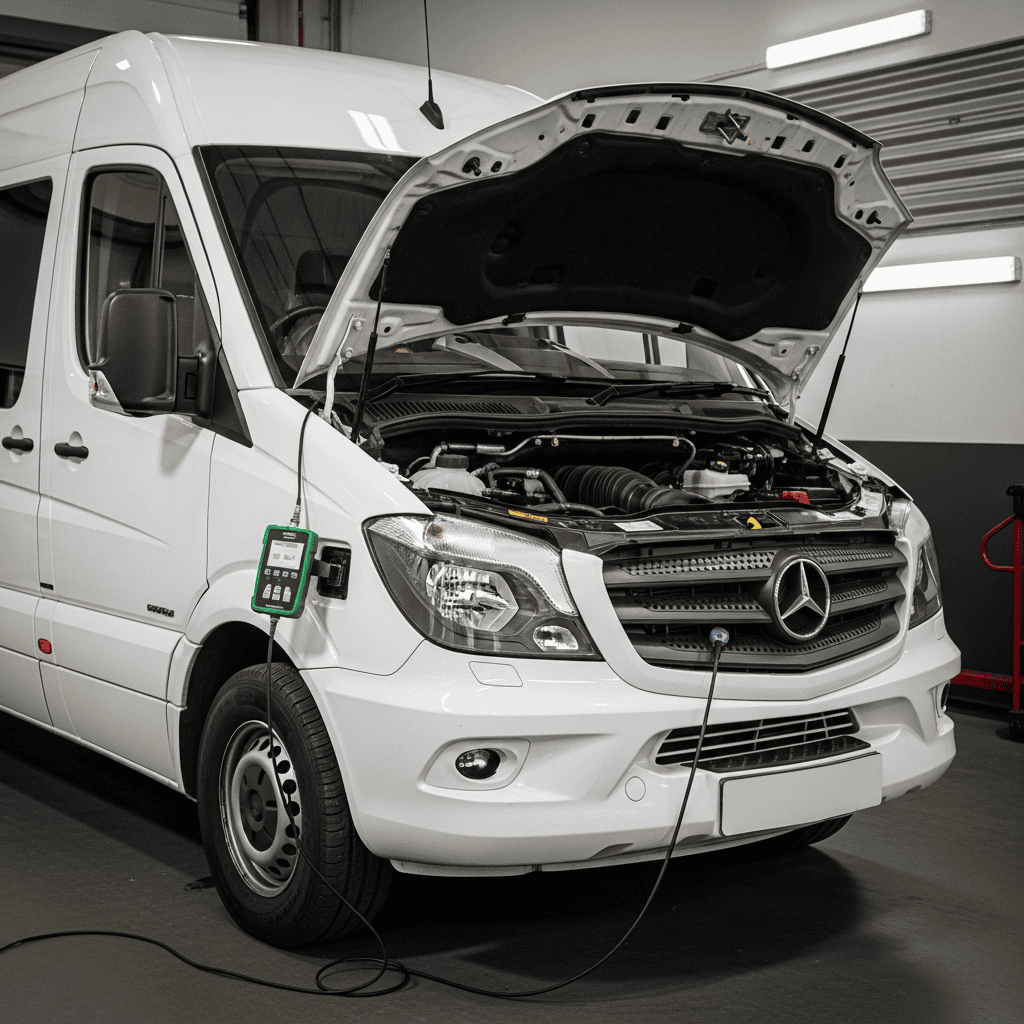
If you are seeing any of these signs on a machine in regular use, the filter pressure data is the next step. A specialist can connect to the ECU diagnostics port, read the live differential pressure across the filter, and determine exactly how loaded the DPF is before deciding on the best course of action.
How professional plant DPF cleaning works
Mobile on-site cleaning
The most practical solution for plant and agricultural machinery is mobile, on-site DPF cleaning. Unlike road vehicles — which can be driven to a workshop — most plant machinery cannot be transported easily without specialist low-loaders and significant additional cost. Mobile cleaning brings the specialist to the machine, reducing downtime to hours rather than the days a transport-and-workshop approach can take.
What the process involves
A professional plant DPF clean typically follows a staged approach:
- Diagnostic scan — live ECU data is pulled to assess filter loading, active fault codes, and regeneration history
- Forced regeneration attempt — if filter loading is within range, a specialist-triggered forced regeneration is the first line of treatment
- Chemical treatment — for moderately loaded filters, a specialist DPF cleaning fluid is introduced to soften and dislodge accumulated deposits
- Pneumatic or thermal cleaning — for heavily loaded filters, removal and off-machine cleaning is sometimes required. Pneumatic cleaning typically takes around 8 hours; thermal cleaning up to 24 hours
- Post-clean verification — filter pressure readings are taken before and after to confirm the cleaning has been effective
The goal in every case is to restore the filter to a condition where the forced regeneration cycles can run effectively again, rather than treating the symptom repeatedly.
When to schedule cleaning — before the problem, not after
The most disruptive point to deal with a blocked DPF is the one most plant operators arrive at: mid-job. A digger that goes into limp mode on day three of a five-day groundworks contract, or a combine harvester that derates at peak harvest, creates problems far beyond the cost of the DPF clean itself.
A planned approach is far more cost-effective. For agricultural machinery, scheduling a DPF check before harvest season removes the risk of an unexpected failure at the worst possible time. For construction equipment on a long contract, a DPF check at mobilisation is standard practice for better-run operations. For an overview of what DPF cleaning typically costs across different machine types, our DPF cleaning cost guide covers the main variables.
Our commercial fleet and plant DPF services cover machinery across the West Midlands and Worcestershire. We work around operational schedules to minimise disruption — the same mobile, on-site approach we use for road fleet vehicles, adapted to the specific demands of off-road equipment.
Plant or agricultural DPF giving you problems?
We offer free diagnostics on plant and agricultural machinery across the West Midlands. We come to the machine — not the other way round.
Frequently asked questions
Can a tractor DPF be cleaned rather than replaced?
In most cases, yes. A heavily loaded but undamaged DPF can be cleaned using specialist forced regeneration, chemical treatment or off-machine pneumatic or thermal cleaning. Replacement becomes necessary when the filter substrate has been mechanically damaged or when repeated cleaning is no longer restoring performance — typically the result of leaving a blockage too long without attention.
How often should plant machinery DPF be cleaned?
There is no fixed interval — it depends on operating duty cycle. Machines that idle frequently or work in short cycles build up soot faster than those running at sustained load. A practical approach is to have the filter pressure checked every 500 to 750 hours of operation, or whenever the DPF warning light appears. Checking before peak season avoids unplanned downtime.
What are the signs of a blocked DPF on a digger?
The most common indicators are the DPF or engine management warning light on the dashboard, a noticeable reduction in digging or lifting power, excessive black smoke on startup, and the machine entering a derate or limp mode. On some machines, the display will show an active regeneration cycle that does not complete and clear.
Does plant machinery DPF cleaning require filter removal?
Not always. Mild to moderate blockages can often be cleared in place using diagnostic-triggered forced regeneration or chemical treatment. Heavily loaded or ash-saturated filters may require removal for pneumatic or thermal cleaning. A diagnostic scan before any work determines which approach is appropriate for the specific level of loading.