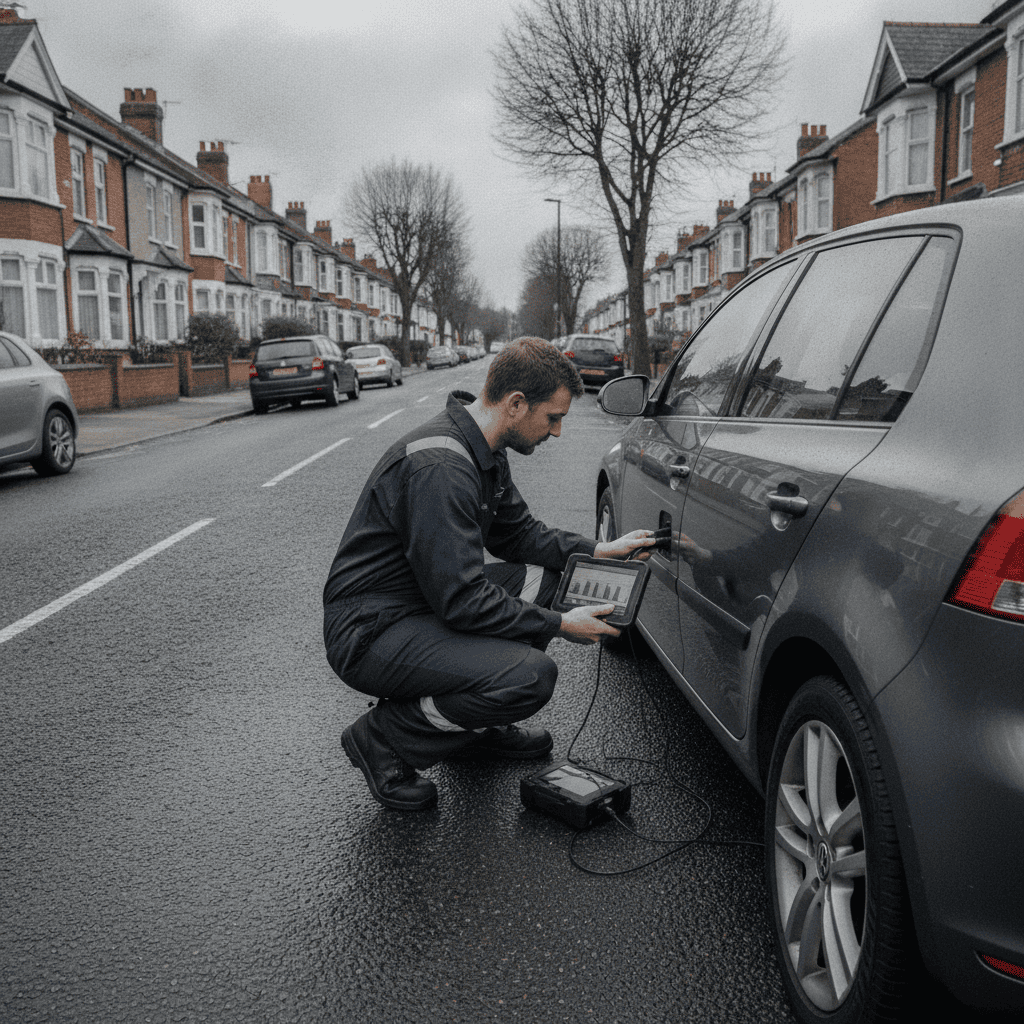
Getting your DPF cleaned is the right first step — but what happens next matters just as much. Without some changes to how the vehicle is used and maintained, many drivers find themselves back with the same problem within a few months. This guide explains what to do after a DPF clean to give the filter the best chance of staying clear long-term.
In this guide
- Why DPFs block again after cleaning
- How to drive in the days after a DPF clean
- Oil choice and its effect on your DPF
- Understanding when regeneration is happening
- Warning signs to watch for after cleaning
- Addressing underlying engine causes
- How long a cleaned DPF should last
- Frequently asked questions
Had your DPF cleaned and want to make it last?
If your warning light returns sooner than expected after a clean, it is worth getting a diagnostic check to rule out an underlying engine issue driving repeat blockages.
Why DPFs block again after cleaning
A professionally cleaned DPF removes the accumulated soot and, where applicable, ash deposits that caused the original blockage. The filter itself is restored to something close to its original flow characteristics. But the filter does not change the way the vehicle is driven or the engine’s underlying condition — and both of those factors directly influence how quickly the DPF loads up again.
The two main reasons a DPF blocks again after cleaning are driving pattern and engine condition. A vehicle used almost entirely for short urban journeys will reload its DPF faster than one with regular longer runs, because passive regeneration — the natural self-cleaning process — cannot complete properly on short trips. And a vehicle with an underlying engine issue, such as a faulty EGR valve, worn injectors, or excessive oil consumption, produces more soot than a healthy engine, loading the filter faster than regeneration can cope with.
Neither of these is a reason to avoid cleaning — cleaning is still the right first step in most cases. But understanding what leads to re-blockage helps you extend the interval between services and reduces the chance of the same problem recurring within weeks.
How to drive in the days after a DPF clean
The most practical thing you can do in the first few days after a DPF clean is to allow the vehicle to complete a full regeneration cycle. This confirms the regen system is working properly, helps the ECU recalibrate the filter’s baseline pressure readings with a clean filter, and gives you a reliable reference point for normal operation going forward.
The post-clean regeneration drive
A successful regeneration typically requires 20 to 40 minutes of continuous driving at motorway or dual carriageway speeds — generally above 50 mph — where the engine is working under a reasonable load and exhaust temperatures are high enough to initiate and sustain the regeneration process.
This is not about thrashing the engine. It is about maintaining a steady, consistent speed for long enough that the ECU can trigger and complete a passive regen cycle naturally. A return motorway journey of 30 to 40 minutes is sufficient for most vehicles.
If your normal routine does not include long drives, try to build in one motorway run per week or every two weeks. This does not need to be a dedicated trip — a longer commute route on certain days or a regular weekend drive at higher speeds is often sufficient to keep passive regen working properly.
Good to know: After a DPF clean, the ECU may take one or two drive cycles to fully reset its soot loading estimate to zero. If the warning light comes on briefly after a clean and then clears on its own after a longer drive, this is often normal and not a sign that the clean has failed.
Avoiding short journeys immediately after the service
In the first few days after a clean, try to avoid using the vehicle exclusively for very short journeys — under 10 to 15 minutes. This is when passive regeneration is least likely to complete, and starting the new cycle with repeated short trips gives the filter little chance to self-manage.
If you do need to use the vehicle for short trips, try to combine them with one longer run whenever possible, rather than allowing the car to cool down fully between each short journey.
Oil choice and its effect on your DPF
Engine oil has a direct effect on how quickly ash builds up inside the DPF. When engine oil burns in the combustion process — which happens at a small but continuous rate in all engines — the additives in the oil leave behind non-combustible residue that passes through the exhaust and accumulates in the filter as ash.
Unlike soot, ash cannot be removed by regeneration. It builds up permanently over time and gradually reduces the filter’s capacity. The rate at which this happens depends partly on the oil you use.
Using the correct low-SAPS oil
Modern diesel vehicles with DPFs require a low-SAPS (Sulphated Ash, Phosphorus, Sulphur) engine oil. These oils are specifically formulated to minimise the ash residue left inside the filter. Standard engine oils — including some labelled as “fully synthetic” — contain higher levels of these additives and will accelerate ash accumulation in the DPF over time.
The correct oil specification for your vehicle will be in the owner’s manual and is typically indicated by an ACEA standard — commonly C2 or C3 for vehicles with DPFs. If you are unsure whether the oil currently in your vehicle is the correct specification, check the oil filler cap, the service history, or consult a mechanic.
Using the correct oil will not eliminate ash loading entirely — that is an unavoidable byproduct of the DPF system — but it significantly slows the rate at which ash accumulates and extends the time before deep cleaning or replacement is needed.
Understanding when regeneration is happening
Passive regeneration is invisible to the driver — the car does it automatically without any indication on the dashboard. But being aware of the conditions that trigger it helps you recognise whether your driving patterns are giving the filter enough opportunities to self-clean.
Regeneration is most likely occurring when you are driving at 50 mph or above for a sustained period, the engine is under a moderate load (not just idling), and exhaust temperatures are high enough — typically above 500 to 600 degrees Celsius — to oxidise the accumulated soot. These conditions are most reliably achieved on motorways and dual carriageways.
Active regeneration
When passive regeneration has not been completing often enough and soot loading reaches a threshold, the ECU may trigger active regeneration. This uses post-injection of fuel to raise exhaust temperatures high enough to initiate the burn-off cycle even at lower speeds or loads.
Active regeneration typically lasts 10 to 20 minutes and usually completes without the driver noticing. Some vehicles show a brief increase in idle speed or a slightly stronger exhaust smell during an active regen cycle. Interrupting an active regen by switching the engine off before it completes leaves the filter at an intermediate loading state and often requires the cycle to restart from the beginning on the next journey.
Practical tip: If your car’s fuel consumption increases noticeably for a period before returning to normal, this may indicate an active regeneration cycle has been occurring more frequently than usual. This can be normal if you have been doing more short journeys — but if it persists, it is worth checking whether an underlying cause is increasing soot output.
Warning signs to watch for after cleaning
After a professional DPF clean, the filter should perform as expected for a significant period. Certain signs in the weeks following a clean are worth paying attention to, as they may indicate either that an underlying issue is causing faster-than-normal re-loading, or that a component involved in the DPF system needs attention.
- DPF warning light returning within a few weeks — If the warning light reappears within a month or two of a professional clean, this is unusual and suggests either an engine issue driving excessive soot production, or a pressure sensor fault giving a false reading.
- Frequent active regeneration cycles — Noticeably increased fuel consumption or more frequent exhaust smell without an obvious change in driving pattern.
- Limp mode returning without a long journey — If the vehicle drops into limp mode again without having done a significant number of short journeys, something else may be contributing to the fault.
- Engine warning light alongside the DPF light — This combination often indicates a secondary fault — EGR valve, injector, or turbo — that is affecting soot output or the ECU’s ability to manage regeneration properly.
Any of these signs is worth investigating with a free DPF diagnostic check rather than waiting for the situation to worsen.
Addressing underlying engine causes
In some cases, a DPF blocks repeatedly in a short period not because of driving pattern but because of an engine fault that is producing excessive soot output. If the root cause is not addressed, even the best-maintained DPF will continue to block faster than regeneration can handle.
EGR valve issues
A stuck-open or poorly functioning EGR (exhaust gas recirculation) valve increases the amount of exhaust gas recirculated through the combustion process. This lowers combustion temperatures and increases soot output — loading the DPF faster than the regen system can clear it. For more detail on the connection between the EGR system and DPF blockage, see our guide on how a faulty EGR valve causes DPF problems.
Injector wear or fuelling faults
Worn or leaking injectors produce poor spray patterns that result in incomplete combustion and higher soot output per engine cycle. This directly increases the rate at which the DPF loads up. If soot loading is consistently faster than it should be for the vehicle’s driving pattern, injector condition is worth checking as part of the diagnostic process.
Excessive oil consumption
An engine burning more oil than normal — through worn piston rings, valve stem seals, or turbo seal failure — passes additional oil-derived compounds through the exhaust. These contribute to both soot and ash loading in the DPF and can also contaminate the pressure sensor pipes. If oil levels are dropping more quickly than expected, this is worth investigating separately from the DPF issue.
How long a cleaned DPF should last
There is no single answer to this because it depends heavily on driving pattern, engine condition, and whether the correct oil is being used. A vehicle used predominantly on motorways with a healthy engine and correct oil could go several years between DPF cleaning interventions. A vehicle used almost exclusively for short urban journeys with an engine producing above-average soot may need attention more frequently.
As a general reference point, a professionally cleaned DPF on a vehicle used for mixed driving should not need attention again within the first 12 to 18 months under normal use. If the interval is significantly shorter than this, it is worth investigating the driving pattern and engine condition rather than simply repeating the cleaning.
DPF Clean Specialist offers mobile DPF cleaning across the West Midlands, coming to your location at home, work, or roadside. If you are concerned about why your DPF is loading up faster than expected, a free diagnostic assessment will help identify whether an underlying cause is contributing to the repeat blockage.
Want to make your DPF clean last longer?
If your warning light has returned after a recent clean, we can run a free diagnostic check to identify whether an underlying cause is driving faster-than-normal loading. Mobile service across the West Midlands.
Frequently asked questions
How long after a DPF clean before I can do normal driving again?
You can drive normally straight away. In the first few days, it is beneficial to include at least one longer sustained drive — ideally 30 minutes or more at motorway speeds — to allow a full passive regeneration cycle to complete. After that, normal use can resume.
Should I use a DPF cleaning additive after a professional clean?
Fuel-borne DPF additives can help support passive regeneration on vehicles that do primarily short journeys, but they are not a substitute for professional cleaning when the filter is already heavily loaded. If your DPF has just been professionally cleaned, your priority should be adjusting your driving pattern rather than relying on additives.
My DPF warning light came back two weeks after cleaning — has the clean failed?
A quick return of the warning light after a professional clean usually points to an underlying issue rather than a failed clean. Common causes include an engine fault increasing soot production, a pressure sensor giving a false reading, or a driving pattern that prevents regeneration from completing. A diagnostic check will identify the cause.
Does the type of fuel I use affect my DPF?
The main fuel-related factor is avoiding bio-diesel blends above the limit specified for your vehicle, as these can affect regeneration temperatures and oil dilution risk. Using quality fuel from reputable retailers is generally advisable, but the fuel specification has less impact on DPF health than oil specification and driving pattern.
Can I prevent ash build-up in my DPF?
Ash accumulation cannot be entirely prevented — it is a normal byproduct of the DPF system over time. However, using the correct low-SAPS engine oil specified for your vehicle significantly slows the rate of ash accumulation. Choosing the right oil at each service is the most practical step you can take to extend the interval before ash-related deep cleaning is needed.