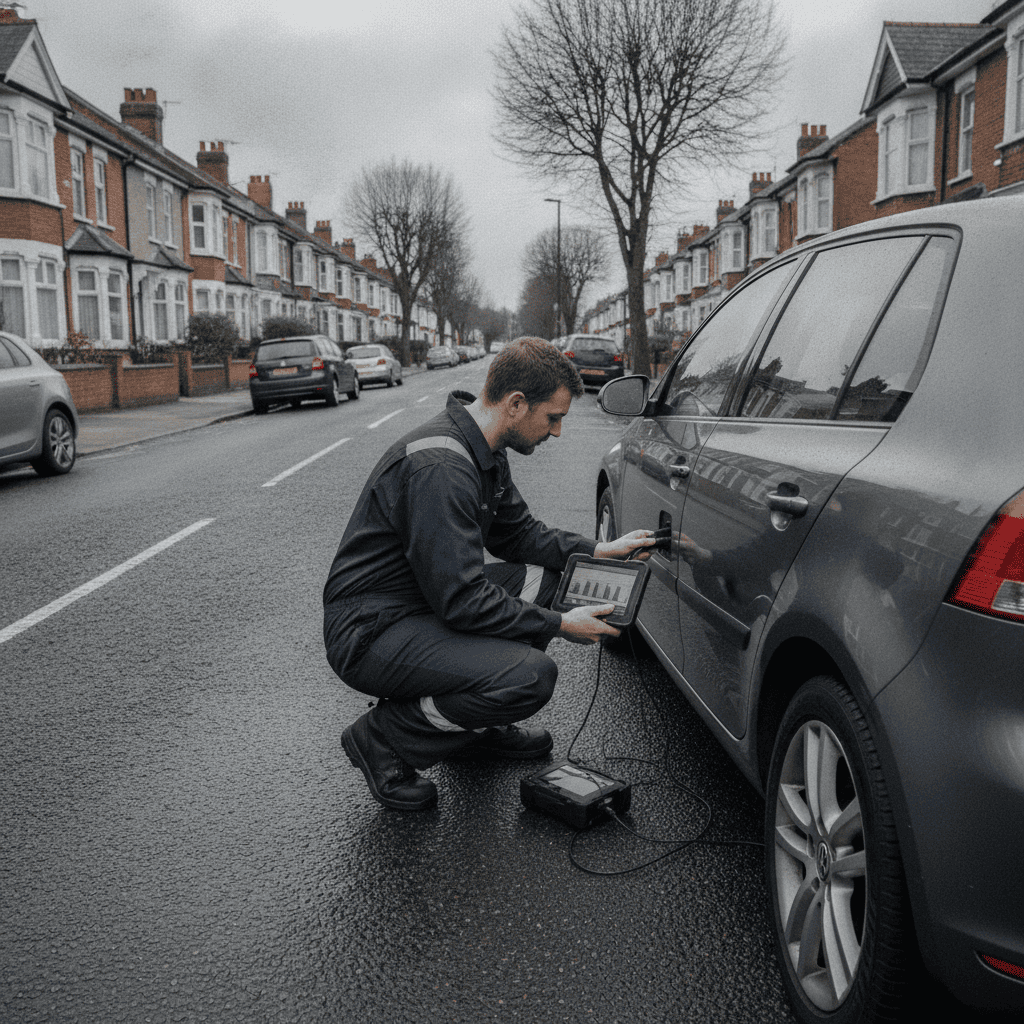
A DPF diagnostic check is the most important step before any work is done on your diesel particulate filter — but many drivers aren’t sure what it actually involves. This guide walks through exactly what happens during a proper DPF diagnostic assessment, what the results mean, and why getting the diagnosis right saves money and avoids unnecessary repairs.
In this guide
Book a free DPF diagnostic check
We come to your home, workplace, or roadside location across the West Midlands. No obligation — diagnostics first, recommendations after.
Why diagnostics come before any DPF work
The diesel particulate filter is one of the more complex systems on a modern diesel vehicle. When something goes wrong — warning lights, limp mode, poor performance — the symptoms often point in several directions at once. The same warning light can indicate a soot-blocked filter, a faulty pressure sensor, a blocked pressure pipe, a failing EGR valve, or something else entirely.
Acting without a proper diagnosis means you might spend money on the wrong fix. A driver who pays for DPF cleaning when the real problem is a blocked pressure pipe will find the warning light returns quickly, because the underlying cause was never addressed. A driver who replaces an expensive pressure sensor when the pipe just needed clearing wastes several hundred pounds unnecessarily.
Diagnostics take the guesswork out of the equation. They tell you specifically what is wrong, how serious the issue is, and which repair or service is actually warranted. At DPF Clean Specialist, the diagnostic assessment always comes before any recommendation — which is why free DPF diagnostics are offered as the starting point for every job.
What a DPF diagnostic check looks at
A thorough DPF diagnostic check covers several distinct areas. Each one contributes to a complete picture of the filter’s condition and what’s causing any fault.
The diagnostic port connection
The process begins with connecting a diagnostic tool to the vehicle’s OBD port — the standardised socket, usually located under the dashboard, that gives access to the vehicle’s onboard computer systems. This allows the technician to read stored fault codes, access live data streams from sensors across the vehicle, and in some cases command specific functions such as forced regeneration.
The diagnostic tool used matters. A basic code reader retrieves fault codes but nothing more. A professional-grade diagnostic scanner accesses live data from multiple sensors simultaneously, shows real-time pressure readings, temperature values, and soot loading estimates, and gives the technician the information needed to diagnose the fault accurately rather than guessing from codes alone.
Fault code retrieval and interpretation
When the vehicle’s ECU detects a problem, it stores a diagnostic trouble code (DTC). These codes are a useful starting point — they indicate which part of the system flagged a fault — but they don’t always identify the root cause on their own.
A code like P2452 or P2453 points to the DPF differential pressure sensor circuit. But the same code can appear if the sensor itself has failed, if one of the pressure pipes is blocked, or if there is a wiring fault. Reading the code tells you where to look; the live data tells you what’s actually happening.
The diagnostic process includes reviewing all stored codes across the relevant systems, not just codes that are immediately active. Intermittent faults that have cleared themselves but left a stored record often provide important context about what the vehicle has been experiencing over time.
Fault codes: what they tell you and what they don’t
Fault codes are the most commonly misunderstood part of DPF diagnosis. It’s not unusual for drivers to have codes read at a parts shop or a basic garage, get told “it’s the DPF sensor” or “it’s the filter,” and spend money accordingly — only for the problem to return.
A code identifies the system and circuit that triggered the fault. It does not confirm the component that needs replacing. Two vehicles with exactly the same fault code can require completely different repairs depending on what the live data shows.
Important: Clearing fault codes without addressing the underlying cause is a short-term fix only. The code will return — usually quickly — because the condition that triggered it hasn’t changed. A proper diagnosis identifies the cause; clearing codes without fixing it just resets the warning light temporarily.
This is why professional diagnostics look beyond the code list and into the live behaviour of the system. A code pointing to the pressure sensor circuit gets followed up with a live data check of what the sensor is actually reading at different engine speeds and conditions. A stuck reading, an erratic reading, or a reading that makes no sense in context of the engine’s operating state all point to different likely causes.
Live data readings during diagnostics
The most valuable part of a proper DPF diagnostic check is the live data. This gives the technician a real-time view of how the DPF system is performing under actual operating conditions, not just a snapshot of stored fault history.
DPF differential pressure
The differential pressure reading — the pressure difference between the inlet and outlet sides of the filter — is the primary indicator of how loaded the filter is with soot and ash. At idle on a clean filter, this value should typically be very low, often under 10 mbar. As soot builds up, back pressure increases and the reading rises.
During diagnostics, the technician observes this reading across a range of engine speeds to see how it behaves. A reading that is stuck at zero regardless of engine load suggests a blockage in the pressure pipes or a failed sensor rather than a clean filter. A reading that spikes unrealistically high on a recently serviced vehicle points to a sensor problem. A reading that rises steadily as expected but has reached a high value confirms genuine filter loading. For a detailed explanation of what specific pressure figures mean, see the guide to DPF pressure readings explained.
Soot and ash loading estimates
Most modern diagnostic platforms can calculate an estimated soot loading percentage based on the pressure differential and engine operating data. This figure gives a practical indication of how close the filter is to its limits and whether a forced regeneration is likely to clear it or whether physical cleaning is needed.
A soot loading below around 50 to 60 percent often indicates that a professionally performed forced regeneration has a reasonable chance of clearing the filter. Above that threshold, or where multiple failed regeneration attempts have occurred, professional cleaning is typically the right route.
Temperature readings
Exhaust temperature upstream and downstream of the DPF is checked to confirm that regeneration conditions can be achieved and that the system is functioning as expected during any attempted regen cycle. Low or stalled temperature readings can indicate a fault with the post-injection system or other components involved in raising exhaust temperatures for regeneration.
EGR and fuelling checks
Because EGR faults and fuelling problems can significantly increase soot output and contribute to repeated DPF blockages, a thorough diagnostic assessment includes checking for related faults in adjacent systems. Identifying an underlying cause — such as a partially stuck EGR valve — is important because it explains why the filter blocked and informs what needs to happen to prevent a repeat.
Physical checks alongside live data
Electronic diagnostics are complemented by a physical inspection of accessible components. The pressure pipes connecting the sensor to either side of the filter are a common source of problems and are worth checking directly — these small pipes can become partially blocked with soot or condensation over time, causing inaccurate sensor readings without any fault in the sensor itself.
The condition of visible DPF-related components, the state of any accessible connectors, and signs of oil or fuel leaks that might be contributing to soot generation are also noted as part of a thorough assessment.
Good to know: Blocked pressure pipes are one of the most frequently missed causes of DPF warning lights and sensor fault codes. They’re inexpensive to clear or replace but are often overlooked when someone goes straight to sensor or filter replacement without a proper physical check.
What happens after the diagnostic check
Once the diagnostic check is complete, the technician has a clear picture of what is causing the fault and what is needed to resolve it. The possible outcomes typically fall into a few categories:
| Diagnostic finding | Likely next step |
|---|---|
| Moderate soot loading, intact filter, no sensor fault | Forced DPF regeneration |
| High soot loading, failed regeneration attempts | Professional DPF cleaning |
| Blocked pressure pipes, sensor reading inaccurate | Clear or replace pressure pipes; retest |
| Failed pressure sensor confirmed by live data | Sensor replacement; retest after |
| EGR or fuelling fault contributing to soot output | Address root cause alongside filter work |
| Physical damage to filter substrate | Filter replacement (cleaning won’t restore structural damage) |
In most cases the path forward is clear once the diagnostic check is complete. Where the picture is more complex — for example, where there is both a sensor issue and genuine filter loading — the technician explains the full situation and the options available, in order from most cost-effective to most comprehensive.
If the car has already reached a point where it is off the road or in limp mode and the situation needs urgent attention, emergency DPF call-out is available for situations that can’t wait for a standard appointment.
What to expect when booking
DPF diagnostics at DPF Clean Specialist are carried out at your location — at home, at work, or roadside across the West Midlands. There’s no need to arrange a garage appointment or have the vehicle recovered if it’s still driveable.
The diagnostic check itself typically takes around 30 to 45 minutes depending on the vehicle and the complexity of the fault. During that time the technician connects to the vehicle, reads stored codes, observes live data, and carries out any relevant physical checks.
At the end of the assessment you’ll have a clear explanation of what’s causing the fault and what the recommended next step is. There’s no obligation to proceed with any further work at that point — the diagnostic outcome is yours to act on in whatever way makes sense for the vehicle and your situation.
For those who prefer mobile DPF diagnostics, the service is available with the technician attending at your chosen location across the West Midlands.
Find out exactly what’s causing your DPF fault
Free DPF diagnostic check at your location — no obligation, no guesswork. West Midlands including Birmingham, Wolverhampton, Walsall, Lichfield and surrounding areas.
Frequently asked questions
How long does a DPF diagnostic check take?
A thorough DPF diagnostic assessment typically takes around 30 to 45 minutes. More complex faults — where multiple systems are involved or where the root cause isn’t immediately clear from the initial data — may take a little longer to work through properly.
Can I get a DPF diagnostic check done at home?
Yes. DPF Clean Specialist offers mobile diagnostics across the West Midlands, attending at home, work, or roadside locations. You don’t need to take the vehicle to a garage — the diagnostic equipment and technician come to you.
What if the diagnostic check doesn’t find a fault?
If the check doesn’t identify an active fault, the technician will explain what was checked and what the readings showed. Intermittent faults can be harder to capture on a single check — if the problem recurs, a follow-up diagnostic with fresh data is the most reliable way to track it down.
Do I need diagnostics if I’ve already had a code read elsewhere?
A basic code read gives you fault codes but not the live data needed to confirm the cause. If you’ve had codes read at a parts shop or a garage that only checked codes without live sensor data, a full diagnostic assessment is still worthwhile — particularly if the repair recommended hasn’t resolved the problem.
Is a DPF diagnostic check the same as a general car diagnostic?
A general diagnostic scan reads codes across vehicle systems. A dedicated DPF diagnostic goes further — it analyses live pressure sensor data, soot loading estimates, temperature readings, and related system behaviour in detail. For accurate diagnosis of a DPF fault, the specialist assessment gives a much more complete picture than a basic code read.