DPF Pressure Readings Explained: What the Numbers Really Mean
If your car shows a DPF fault, a garage often talks about “pressure readings”.
This post explains what those readings measure, what “normal” looks like, and when it’s time to book a proper diagnostic.
A DPF pressure reading is not a guess.
It’s a measurement of how hard the engine has to push exhaust gas through the DPF.
When pressure rises, the DPF may be loading up.
Sometimes it just needs the right drive cycle.
Other times it needs cleaning, regeneration, or fault-finding because something else caused the soot build-up.
What should a DPF pressure sensor read?
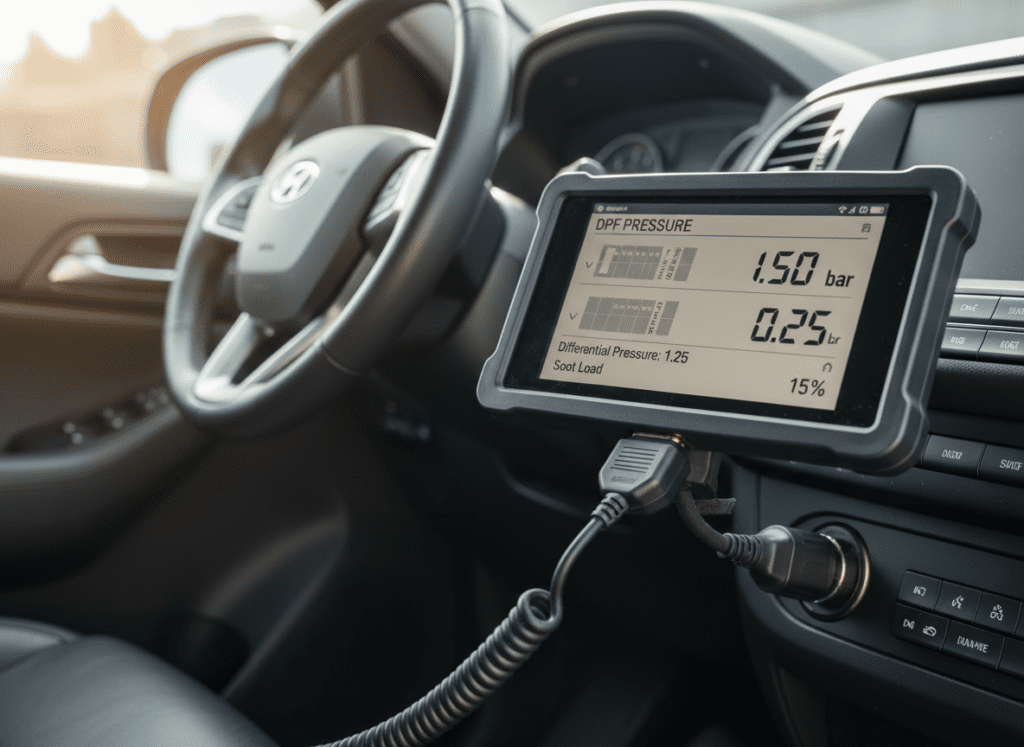
On a healthy filter, DPF differential pressure is usually around 5–15 mbar at idle and rises with engine speed and load. There is no single “correct” number — the right value depends on the vehicle, engine size and how much soot the filter is holding.
| Engine state (healthy filter) | Typical differential pressure |
|---|---|
| Key on / ignition only | ~1–5 mbar |
| Warm idle | ~5–15 mbar |
| Driving (~2,000 rpm) | ~15–40 mbar |
| Hard acceleration / load | rises higher again with flow |
Readings that stay high are the real clue: roughly 20–40 mbar suggests moderate soot, 40–80 mbar heavy soot, and 80 mbar+ under load a filter that is likely blocked and needs regeneration or cleaning. Values vary by vehicle, so read the trend and the RPM/load context, not a single number.
Quick takeaway
- Pressure readings help show DPF restriction, not the full cause.
- One reading means very little without engine load and RPM context.
- The right next step depends on what the car is doing, not just the number.
If you’re seeing warning lights or limp mode, start here as well:
DPF warning signs and when cleaning makes sense
.
When pressure readings stay high
If differential pressure remains elevated even after proper driving conditions, the DPF may require professional cleaning rather than another drive cycle attempt. Our mobile DPF cleaning service operates across the West Midlands and can diagnose whether the issue is soot loading, ash restriction, or an underlying regeneration fault.
What a DPF pressure reading actually measures
Most vehicles use a differential pressure sensor.
It measures the difference between pressure before the DPF and pressure after it.
Low pressure difference
Exhaust flows freely.
The DPF is likely clear, or the engine is under light load.
Rising pressure difference
Exhaust finds more resistance.
The DPF may be loading with soot, ash, or there may be a fault affecting regeneration.
High pressure difference
Restriction is likely significant.
This is when you see poor performance, frequent regens, warning lights, or limp mode.
Why the same number can mean different things
Pressure changes with RPM and load.
A reading at idle is not the same as a reading under acceleration.
A simple way to think about it
- Idle reading tells you if the system looks calm when airflow is low.
- 2,000–2,500 RPM under light load shows how the DPF behaves in normal driving.
- Higher load shows if restriction climbs quickly when the engine works harder.
If the root cause is poor regeneration conditions, this guide helps:
what causes DPF blockages
.
What can push pressure readings up
A “high reading” does not always mean the DPF itself is the only issue.
These are common causes we see behind repeated loading.
If these causes sound familiar and pressure values are climbing, delaying inspection can increase exhaust restriction and strain other components. In many cases, a professional clean restores flow before damage develops. If you are searching for DPF cleaning near you, mobile diagnostics can confirm the correct next step.
Short trips and low exhaust temps
The DPF does not get hot enough for regeneration to complete.
Soot builds faster than it clears.
Faults that stop regeneration
Sensors, boost issues, EGR faults, or temperature problems can block the regen process.
Pressure rises because soot never gets burned off.
Sensor or pipe issues
Split hoses and blocked sensor ports can give misleading readings.
Diagnostics should confirm sensor health before decisions get made.
Ash build-up over time
Ash does not burn off like soot.
It can reduce flow as mileage climbs, even when the engine runs well.
If you’re weighing up options, this is useful context:
DPF cleaning vs replacement
.
What to do if your pressure reading looks high
If you have no warning lights
- Check how you use the car week to week.
- Look for repeated short trips.
- Book a diagnostic if you want certainty.
If you have warning lights or limp mode
- Do not keep clearing codes and hoping.
- Get live data checked properly.
- Use a service that matches the urgency.
If the car needs a regen now
- Forced regeneration can be the right step.
- It still needs checks first.
- Fixing the cause stops repeat problems.
Useful service links:
forced DPF regeneration,
mobile DPF cleaning,
emergency call-out. You can also browse our full range of DPF cleaning services.
Need Professional DPF Cleaning?
High DPF pressure readings are often the early warning before limp mode, frequent regenerations, or full restriction. If readings stay elevated, cleaning may be more effective than repeated forced regens.
We provide mobile DPF cleaning across Birmingham, Wolverhampton and Walsall. View coverage for your area:
DPF Cleaning Birmingham,
DPF Cleaning Wolverhampton,
DPF Cleaning Walsall.
Want your DPF readings checked properly?
A free diagnostic check tells you whether it’s a loading issue, a sensor issue, or a regen problem.
You get a clear next step.
DPF pressure: frequently asked questions
What should my DPF pressure sensor read?
On a healthy filter, the DPF differential pressure sensor typically reads about 5–15 mbar at warm idle, and only a few mbar with the ignition on and the engine off. The reading climbs with engine speed and load — around 15–40 mbar at a steady 2,000 rpm is common. What matters is the trend and the context (RPM and load), not a single figure.
What is normal DPF differential pressure?
For a clean, healthy DPF, normal differential pressure is roughly 5–15 mbar at idle, rising smoothly as you rev or drive. Moderate soot loading tends to show around 20–40 mbar, heavy loading 40–80 mbar, and a filter reading over about 80 mbar under load is usually blocked. Exact “normal” values vary by vehicle, engine size and manufacturer.
What does high DPF back pressure mean?
High DPF back pressure means exhaust gas is struggling to pass through the filter — usually because soot or ash has built up, or because the filter cannot regenerate properly (short trips, low exhaust temperatures, or an underlying fault). It can also be caused by a faulty pressure sensor or blocked sensor pipes reading falsely high. Persistent high back pressure often shows up as warning lights, limp mode or frequent forced regenerations, and needs a proper diagnostic to confirm whether cleaning, regeneration or a sensor repair is the fix.
Related reading: DPF Differential Pressure Readings Explained.