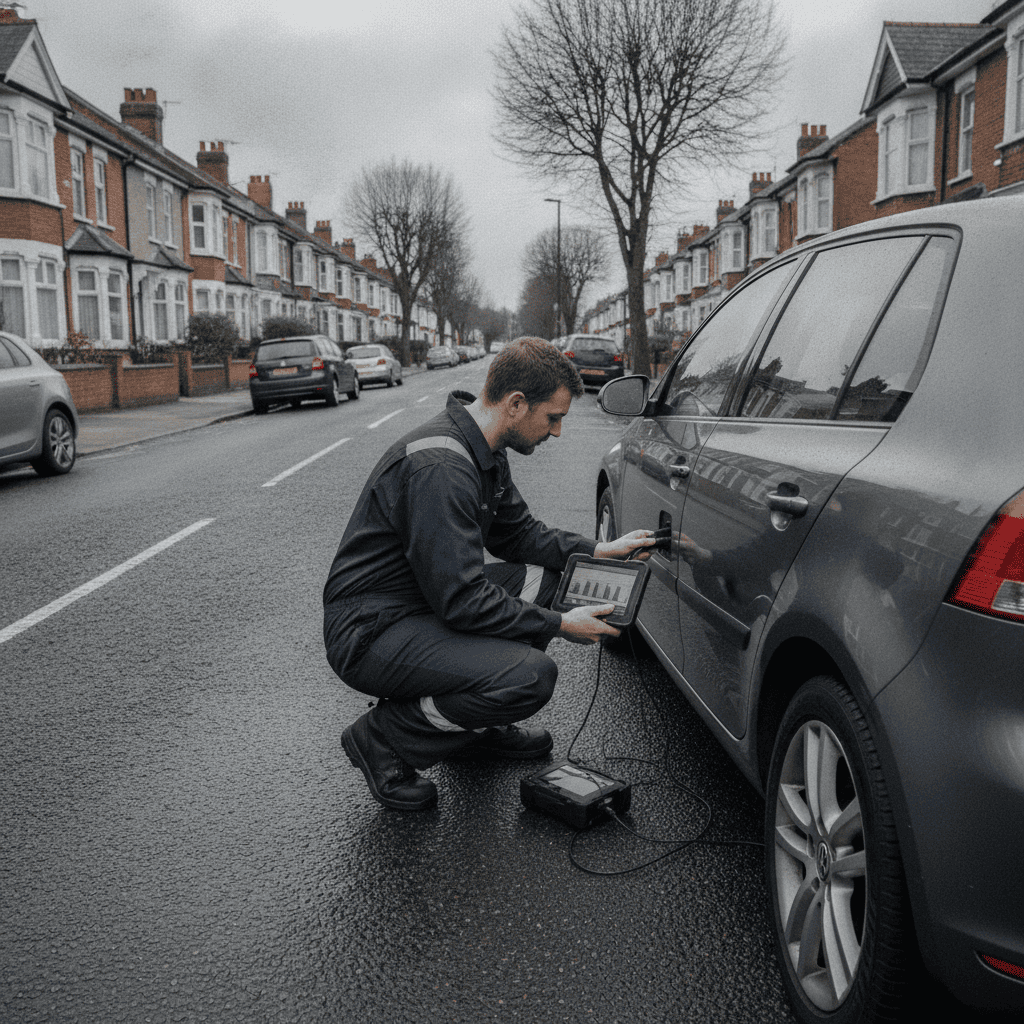
If your diesel vehicle is showing a warning light, entering limp mode, or failing to complete regeneration — but a mechanic has told you the DPF itself looks fine — the pressure sensor may be the cause. This guide explains what to look for, why the fault is commonly confused with a blocked filter, and what mobile diagnostics can tell you before any work begins.
Not sure if it is the sensor or the filter?
Live data from a mobile diagnostic check will show the exact pressure reading, soot load, and regeneration history — confirming the cause before any cleaning or replacement is recommended.
Book free DPF diagnosticsWhat the DPF Pressure Sensor Actually Does
The DPF pressure sensor — also called the differential pressure sensor — monitors the difference in exhaust pressure on either side of the diesel particulate filter. As soot builds up inside the filter, the pressure difference between the inlet and outlet increases. The engine control unit uses this reading to calculate how full the filter is and to decide when to trigger a regeneration cycle.
Without this signal, the ECU cannot reliably manage regeneration. If the sensor is sending incorrect readings, the ECU may believe the filter is full when it is not, or vice versa. Both outcomes cause problems — either unnecessary regeneration attempts or a filter that never clears properly because the ECU does not recognise that it needs to.
For a detailed explanation of how all DPF sensors work together, including temperature and NOx sensors, see our guide on how DPF sensors work. This article focuses specifically on what happens when the pressure sensor itself develops a fault.
The Main Symptoms of a Faulty DPF Pressure Sensor
The symptoms of a faulty DPF pressure sensor are not always easy to identify, because most of them closely resemble the symptoms of a genuinely blocked filter. The key difference is context — a sensor fault can produce these symptoms even when the filter itself is in reasonable condition.
Frequent or failed regeneration attempts
If the sensor is stuck reading a high pressure level, the ECU interprets this as the filter being heavily loaded — even if it is not. It will trigger repeated regeneration cycles, none of which make the warning light disappear because the underlying reading never changes. Each failed regen may also inject excess fuel into the exhaust, which can dilute engine oil over time.
DPF warning light with no obvious cause
A warning light that appears despite recent regeneration, appropriate driving conditions, or a vehicle that has not been doing unusual numbers of short journeys is often the first sign that the sensor rather than the filter is at fault. If cleaning or a forced regeneration has been carried out recently and the light has returned quickly, the sensor is worth investigating.
Limp mode without heavy filter loading
Limp mode is triggered when the ECU detects a serious fault in the exhaust aftertreatment system. A faulty pressure sensor can produce a fault code serious enough to engage limp mode even when the DPF soot load is within normal limits. The vehicle restricts power as a precaution, but the underlying cause is the sensor signal rather than a genuinely blocked filter.
Erratic or impossible pressure readings
When live diagnostic data is connected, a faulty sensor often shows readings that do not match expected values — pressure figures that are too high at idle, too low under load, or that fluctuate without corresponding changes in exhaust conditions. This is often the clearest diagnostic indicator. See our guide on what normal DPF pressure readings look like for reference values at different engine speeds.
Reduced engine performance and poor throttle response
As the ECU responds to what it believes is a worsening filter condition, it may begin restricting fuelling or altering injection timing. This shows up as sluggish acceleration, reduced pulling power, or a vehicle that feels unresponsive before it has fully entered limp mode.
DPF warning light returns quickly after cleaning
One of the most telling signs that the pressure sensor is the issue rather than the filter itself is when a warning light returns within a short period after professional cleaning or a forced regeneration. If the filter has been properly cleaned and verified clear, but the ECU continues to report high soot loading, the sensor is not sending the correct post-clean readings.
Important
Sensor tube blockage can produce the same symptoms as a failed sensor. The two small hoses connecting the sensor to either side of the DPF can become clogged with soot, causing the sensor to read incorrectly without the sensor itself having failed. A mobile diagnostic check will identify which is the case.
Fault Codes Linked to Pressure Sensor Problems
A faulty DPF pressure sensor typically stores one or more OBD fault codes. These codes point to the pressure sensor circuit rather than the filter itself, and they are an important part of distinguishing the two issues during a diagnostic check.
Common pressure sensor fault codes include:
DPF Pressure Sensor A Circuit — a general malfunction detected in the pressure sensor circuit.
DPF Pressure Sensor A Circuit Range / Performance — the sensor voltage reading is outside the expected range.
DPF Pressure Sensor A Circuit Low — the input signal from the sensor is lower than expected.
DPF Pressure Sensor A Circuit High — the input signal is higher than expected, often indicating a stuck or blocked sensor.
DPF Differential Pressure Too High Bank 1 — the pressure difference across the filter exceeds expected limits, which can indicate a blocked filter or a sensor reading too high.
DPF Differential Pressure Too Low — the pressure difference is below expected limits, which can indicate an exhaust leak, sensor fault, or removed filter.
Note
Fault codes confirm there is a problem in the pressure sensor circuit, but they do not automatically confirm the sensor itself has failed. An exhaust leak upstream or downstream of the DPF can also trigger pressure-related codes. Diagnostics must check the full picture before replacement is recommended.
For a more detailed breakdown of the P2455 code specifically, including what causes it on common vehicle types, see our article on the P2455 DPF pressure sensor fault code (coming soon).
Why a Faulty Sensor Looks Like a Blocked DPF
From the driver’s seat, a faulty pressure sensor and a genuinely blocked DPF can produce almost identical symptoms. Both can cause warning lights, limp mode, failed regeneration, and reduced performance. This is why the two faults are so commonly confused — and why the wrong diagnosis leads to unnecessary work.
| Symptom | Blocked DPF filter | Faulty pressure sensor |
|---|---|---|
| DPF warning light | Yes — reflects actual soot accumulation | Yes — reflects incorrect sensor signal |
| Failed regeneration | Yes — filter cannot clear | Yes — ECU does not recognise regen as complete |
| Limp mode | Possible when heavily loaded | Possible from sensor fault code alone |
| Light returns after cleaning | Unlikely if clean was successful | Common — sensor still reads incorrectly |
| Actual soot load in live data | High — confirms blockage | Normal or low — contradicts warning light |
| Sensor voltage readings | Within expected range | Out of range, flat, or erratic |
| Pressure at idle | High if filter is loaded | May read high even on a clean filter |
The critical point is that a pressure sensor fault can only be reliably identified by looking at live diagnostic data — specifically the actual soot load calculation alongside the raw sensor voltage. Without this data, it is not possible to say with confidence whether the issue is the sensor or the filter itself.
This distinction matters commercially. Cleaning a filter that does not need cleaning is wasted expense. More significantly, replacing a filter that has not failed — because the sensor sent false readings — leaves the underlying fault unresolved. The new filter will fail again for the same reason.
Which vehicle types are most commonly affected?
DPF pressure sensor faults can occur across any diesel vehicle fitted with a DPF, but certain makes and models are seen more frequently in practice. Ford Transit vans — particularly those used for delivery or urban trade work — appear regularly due to high duty cycles and the stop-start nature of the routes they cover. BMW 3 and 5 series diesels used mainly on shorter journeys are another common occurrence. Vauxhall Astra, Insignia, and Zafira models with 2.0 CDTi engines also have a known history of pressure sensor and sensor tube issues. Volkswagen Group vehicles — including Audi A3, VW Golf, and Seat León — can experience G505 sensor failures, particularly in older examples.
These patterns do not mean other vehicles are immune. Any diesel with a DPF and a pressure sensor circuit can develop this fault. The vehicle type affects how the fault presents, not whether it can occur.
What Mobile Diagnostics Reveal
A mobile diagnostic check reads data directly from the vehicle’s ECU without the vehicle needing to be moved. This is particularly useful where limp mode makes driving risky. The data pulled during a diagnostic session includes several values that are essential to distinguishing a sensor fault from a filter fault.
Live pressure values
The actual differential pressure reading — measured in mbar or kPa depending on the vehicle — is compared against expected values for the engine speed and operating conditions at the time of the check. A clean filter at idle should show a very low differential pressure reading. If the sensor is reporting high pressure when the filter is confirmed clean, the sensor is not reading correctly.
Soot load percentage
The ECU calculates a soot load figure based on pressure data and driving history. This figure — typically expressed as a percentage — shows how full the ECU believes the filter to be. A sensor fault often reveals itself here: the soot load percentage may be high despite the vehicle having recently completed a long journey or a forced regeneration.
Regeneration history
Diagnostic data can show how many regeneration attempts have been made, how many completed successfully, and how long each took. Repeated short or failed regeneration cycles on a vehicle that has been driven appropriately point toward a signal problem rather than an accumulation problem.
Sensor voltage
The raw voltage output from the pressure sensor can be read directly. Expected voltage at idle on a clean filter sits close to the minimum end of the sensor’s range. Voltage that is flat, stuck at maximum, or fluctuating erratically with no corresponding change in engine speed is a strong indicator of sensor failure or a blocked sensor tube.
Our mobile DPF diagnostics at your location service reads all of this data at your home, workplace, or roadside location across the West Midlands — providing a clear picture of the actual cause before any recommendation is made.
What good diagnostics look like
A proper diagnostic session should always show you live pressure values, soot load percentage, and regeneration history data — not just fault codes. Fault codes alone do not confirm whether the sensor, the filter, or the sensor tubes are the root cause. If you have been given a diagnosis based on codes only, it is worth requesting a full live data review before committing to any work.
Sensor Problem or Filter Problem — How to Tell
Based on diagnostic data, the distinction between a pressure sensor fault and a genuine DPF blockage typically comes down to three checks.
- Soot load is within normal limits but the warning light is active — points toward a sensor fault rather than filter loading
- Live pressure readings do not correlate with engine speed changes — a clean filter should show rising pressure as revs increase; a stuck reading suggests a sensor or tube problem
- Warning light returned quickly after a confirmed successful regeneration or professional clean — indicates the ECU is not receiving the correct post-regen signal from the sensor
- Fault codes are specifically in the P2452–P2455 range — these point to the sensor circuit rather than filter loading or regeneration failure
- Sensor voltage is outside expected range at idle — a healthy sensor should produce a low, stable voltage when the filter is clean
Where these checks confirm the sensor is the issue, the next step is to determine whether the sensor itself has failed or whether the sensor tubes — the small hoses connecting the sensor ports to either side of the DPF — are blocked with soot. Tube blockage is resolved by clearing or replacing the hoses. Sensor failure requires sensor replacement, followed by recalibration to ensure the ECU relearns the correct baseline values.
In either case, simply replacing the sensor without addressing the underlying cause — for example, a heavily loaded filter that blocked the sensor tubes — will lead to the fault returning.
For more on what normal and abnormal pressure readings look like at different load conditions, see our full guide on what normal DPF pressure readings look like.
Not Sure If It Is the Sensor or the Filter?
Live diagnostic data confirms the cause before any work is recommended. We attend your home, work, or roadside location across the West Midlands — no garage visit needed.
Free diagnostics · Transparent pricing · No hidden fees · Same-day where possible
Frequently Asked Questions
Can a faulty DPF pressure sensor cause limp mode?
Yes. Limp mode is triggered when the ECU detects a serious fault in the exhaust aftertreatment system. A faulty pressure sensor can generate a fault code serious enough to engage limp mode even when the DPF filter itself is not heavily loaded. The vehicle restricts power as a precaution, but the underlying cause is the incorrect sensor signal rather than a blocked filter. A diagnostic check will confirm this by showing that the soot load calculation does not match the warning condition.
How do I know if it is the sensor or the DPF filter that has failed?
The most reliable way is a mobile diagnostic check using live data. If the soot load percentage is within normal limits, the sensor voltage is outside its expected range, or the pressure readings do not change with engine speed as they should, the evidence points toward a sensor fault. If the soot load is genuinely high and the pressure readings match expected values for a loaded filter, the filter itself is the more likely cause. Fault codes alone are not sufficient to make this distinction.
Why does my DPF warning light keep coming back after cleaning?
If a DPF warning light returns quickly after professional cleaning or a forced regeneration, it often means the pressure sensor is not sending the correct post-clean readings to the ECU. The filter has been cleared, but the sensor continues to report high pressure or high soot loading. This is one of the most common signs of a faulty sensor or blocked sensor tubes. A diagnostic session after the next appearance of the warning light will confirm whether the clean was genuinely effective and whether the sensor signal is at fault.
Can blocked sensor tubes cause the same symptoms as a failed sensor?
Yes. The two small hoses connecting the pressure sensor to either side of the DPF can become clogged with soot over time, causing the sensor to read incorrectly without the sensor itself having failed electronically. The symptoms are identical — erratic pressure readings, failed regeneration, and warning lights. Clearing or replacing the tubes resolves the issue in these cases, without the cost of a new sensor. A proper diagnostic check distinguishes between the two.
Do you carry out mobile diagnostics for DPF pressure sensor faults in the West Midlands?
Yes. Our mobile DPF diagnostics at your location service covers Birmingham, Wolverhampton, Walsall, Dudley, Lichfield, Telford, and surrounding areas. We read live pressure values, soot load data, sensor voltage, and regeneration history at your home, workplace, or roadside location — giving you a clear picture of whether the pressure sensor, the filter, or another component is the cause before any work is recommended.
We provide mobile DPF cleaning across the West Midlands, including Sutton Coldfield, Tamworth, Lichfield and Walsall — book a free diagnostic and we’ll come to you.