DPF Clean Specialist — West Midlands
The 1.6 HDi Blocks Earlier Than Owners Expect. Here Is Why.
Peugeot and Citroen 1.6 HDi filters have a reputation for filling up at mileages that surprise people. The reason is a combination of engine design, oil finding its way where it should not, and a filter system that was optimised for a driving pattern most owners never do.
Peugeot 1.6 HDi DPF cleaning comes up more often than the mileage on these cars would suggest it should. We see 308s, 3008s, Partners, Berlingos and C4s arriving with a blocked filter well before the point their owners had budgeted for one.
The 1.6 HDi is not a bad engine. It is an engine with a particular set of habits, and if you understand those habits the blocked filter stops being a mystery and starts being predictable, and therefore preventable.
This guide covers what actually fills a 1.6 HDi filter, why oil is so often part of the story, the fault messages you will see on the dashboard and what each one really means, what we check before touching anything, and how mobile cleaning works across Birmingham, the Black Country and South Staffordshire.
The Short Answer
Peugeot and Citroen 1.6 HDi filters block early because the engine runs cool at light load, the cars are mostly used for short urban journeys, and oil carried into the exhaust by a tired turbo or worn seals leaves residue the filter cannot burn away. Cleaning restores the filter, but only once the reason it filled has been identified and dealt with.
That is the summary. The reason it matters is that most 1.6 HDi filters are cleaned twice: once badly, and then again properly six months later.
Five Reasons These Filters Block Early
1. The cars are used almost entirely for short journeys
The 1.6 HDi sold in enormous numbers as a school-run, commuter and light delivery engine. A filter regeneration needs sustained exhaust heat, and a fifteen-minute urban trip ending in a cold car park never delivers it. The engine tries, the cycle is interrupted, and the loading carries over to the next attempt.
2. Small capacity means low exhaust temperature
A 1.6 litre diesel under light load simply does not make much heat. That is excellent for fuel economy and poor for a component whose self-cleaning depends on being hot. Larger diesels get away with the same driving pattern for longer purely because they run warmer.
3. The filter is often not the original one anymore
Many of these cars are on their second filter, and aftermarket replacements vary considerably in substrate quality. A cheaper unit with a coarser substrate can load faster than the original did, which is why a car that had a filter fitted two years ago can be back with the same complaint.
4. Upstream faults keep feeding it
A sticking EGR valve, a failed glow plug or an injector with a poor spray pattern all push more soot downstream than the regeneration strategy was designed to handle. On a small engine there is much less margin to absorb that.
5. Nobody notices the early warning
These cars tend to display a general anti-pollution or emissions message rather than a clear “filter blocked” instruction. It gets read as a sensor glitch, cleared, and ignored until the car goes into limp mode weeks later with a far fuller filter than it had at the first warning.
The Oil Problem Nobody Mentions
This is the part of the 1.6 HDi story that separates a filter that stays clean from one that does not.
These engines are known in the trade for oil supply issues around the turbocharger, and for oil consumption on higher-mileage examples. Oil reaching the exhaust does not burn away in a regeneration the way soot does. It leaves an incombustible residue behind that accumulates permanently and reduces the filter’s usable capacity every single time.
The practical consequence is straightforward. If a 1.6 HDi filter is cleaned while the engine is still passing oil into the exhaust, the clean does not last. The filter starts refilling immediately, and the owner concludes that cleaning does not work — when in fact cleaning worked fine and the underlying fault was never addressed.
Our rule on these cars: if the diagnostic data or the state of the filter points to oil, we say so before any cleaning is quoted. A clean on an oil-fouled engine is money spent on a symptom.
Note that this is a separate matter entirely from the fluid warning some of these cars display, which relates to the filter’s own consumable and is covered in our guide to the fluid warning light on Citroen, Peugeot and Ford diesels.
What The Dashboard Messages Actually Mean
Owners of these cars get told very little by the dashboard, so here is the translation.
- Filter blockage risk / risk of particle filter clogging — the earliest and most useful message. The car is telling you a regeneration has been interrupted repeatedly and it needs a sustained run. Act on this one and you may avoid everything below.
- Anti-pollution fault / emissions fault — a stored fault code somewhere in the emissions system. It is not automatically the filter, which is exactly why it needs reading rather than guessing.
- Depollution system faulty — typically a more advanced state of the same problem, often accompanied by reduced performance.
- Reduced power with capped revs — limp mode. Stop treating this as a driving issue.
The general principle applies to every make: a warning light is information, not an instruction to keep going. Our guide to what to do when the DPF warning light comes on covers the sequence in full.
What We Check, In Order
Cleaning a filter without knowing why it filled is guesswork. On a 1.6 HDi the order matters, because the cheap findings sit at the top.
- Read the stored codes and live data. What did the car actually log, and when. Differential pressure at idle and under load, plus the calculated loading figure.
- Check the pressure sensor and its pipework. Soot in a sensor pipe creates a completely convincing fault on a filter that is fine. It is a common finding and a cheap fix.
- Look for oil. Turbo condition, oil consumption history, and the state of the exhaust upstream of the filter. This is the finding that changes the recommendation.
- Assess soot against residue. Soot can be burned off. Ash and oil residue cannot, and only physical cleaning removes them.
- Confirm nothing upstream is still feeding it. EGR, glow plugs, injectors. Leave one of those and the car returns.
Only then is cleaning worth doing, and only then can anyone tell you honestly how long it is likely to hold. The mechanics of the regeneration cycle itself are explained in our guide to active, passive and forced regeneration.
Clean Or Replace?
The honest answer on a 1.6 HDi is that most filters are cleanable and a minority are not, and the diagnostic tells you which is which rather than the mileage.
Filters that clean well are soot-loaded, structurally sound, and attached to an engine that is not consuming oil. Filters that do not are the ones with a cracked or melted substrate, usually caused by somebody attempting repeated forced regenerations on a filter that was far too full to take one safely.
Where a filter is heavily loaded with residue rather than soot, off-vehicle cleaning is the more thorough route, and we set out how that differs in our guide to off-car DPF cleaning. Replacement is genuinely the last option, not the opening offer.
Where The Law Sits On Removal
Because these cars block early, their owners get offered removal early. It is worth being clear about what that involves.
The DVSA MOT inspection manual is explicit that a filter which has clearly been cut open and rewelded must be rejected unless the presenter can show evidence of a valid reason, such as filter cleaning. Manufacturer-fitted emission control equipment that is missing or obviously modified is a major defect in its own right, and the smoke limits are tight: for vehicles first used on or after 1 January 2014 the default maximum is 0.7m⁻¹, against 1.5m⁻¹ for those first used between July 2008 and the end of 2013.
In other words, a professionally cleaned filter that has been opened and properly resealed with documentation is a recognised legitimate repair. A filter that has been gutted is not. We do not remove filters, and we would rather tell you a filter is finished than sell you a problem.
How The Mobile Service Works
We built the business around mobile on-site DPF cleaning because a car with a warning light and reduced power is not a car anyone wants to drive across a city and leave for two days.
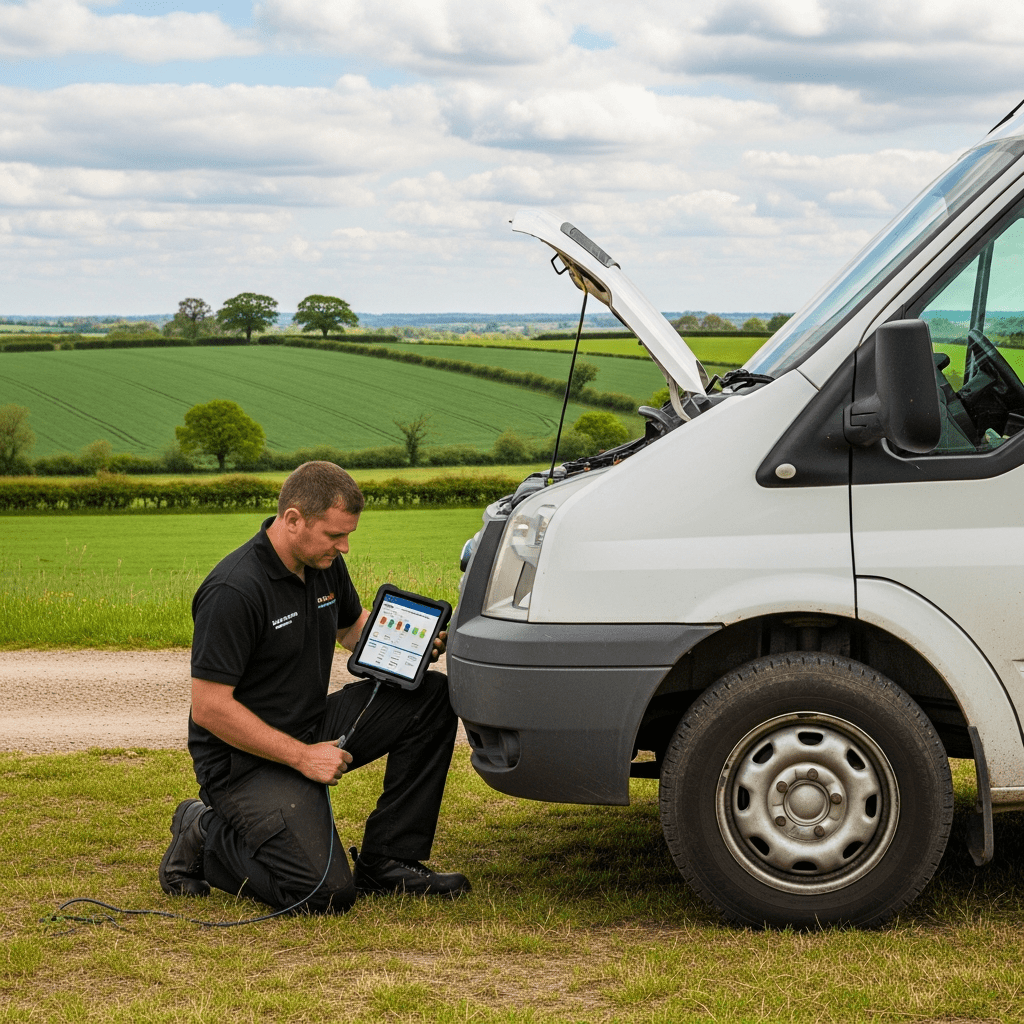
A typical visit runs like this. We attend your home or workplace, connect diagnostics and take full live data before touching anything. You are told what the readings show and what they mean. If cleaning is the right answer it is carried out on the vehicle, and a second scan afterwards confirms the filter is flowing within expected parameters and the ECU counters reflect the work done.
If the data points at oil, or at a filter that is beyond recovery, you get told that on the day. That is a less satisfying conversation than a booking, and it is the right one.
Where We Cover
Birmingham, Walsall, Wolverhampton, Dudley, Solihull, Sutton Coldfield, West Bromwich, Cannock, Lichfield, Tamworth and the surrounding West Midlands and South Staffordshire area. If you are unsure whether your postcode is covered, ask.
1.6 HDi Warning Light On?
Free diagnostics, mobile call-out across the West Midlands, and an honest answer about whether cleaning will actually hold on your car.
Frequently Asked Questions
Why does the 1.6 HDi DPF block so early?
Three things stack up. The engine runs cool at light load, the cars are overwhelmingly used for short urban journeys that never complete a regeneration, and oil reaching the exhaust on higher-mileage examples leaves residue that cannot be burned off. Any one of those is manageable. Together they fill a filter years earlier than the mileage suggests.
Can a 1.6 HDi filter be cleaned, or does it need replacing?
Most can be cleaned. The exceptions are filters with a cracked or melted substrate, which is usually the result of repeated forced regeneration attempts on a filter that was too full to take one. A diagnostic tells you which category yours is in before any money is spent.
What does the anti-pollution fault message mean on a Peugeot or Citroen?
It means a fault has been stored somewhere in the emissions system. It is not automatically the filter. It could be the pressure sensor, its pipework, the EGR valve or a glow plug circuit. It needs reading rather than guessing, because the wrong assumption here is expensive.
Will a forced regeneration clear a blocked filter on these cars?
Only if the loading is within a safe range and the underlying cause has been dealt with. Forcing a regeneration on a filter that is already severely loaded risks damaging the substrate through excessive temperature, which turns a cleanable filter into a replacement.
Is it legal to have the DPF removed from a Peugeot or Citroen?
Removing it means the vehicle no longer has the emission control equipment it was built with, which is a major MOT defect, and the tampering check is separate again. Professional cleaning does not modify the vehicle and does not carry that problem.
Reviewed and signed off by DPF Clean Specialist — Craig Hanson is the lead DPF technician at DPF Clean Specialist, working on diesel particulate filters across Birmingham, the Black Country and South Staffordshire.
Published 29 October 2026 · Last updated 29 October 2026