The call we least like receiving is the one that starts “I had the DPF cleaned six weeks ago and the light is back.” It is a frustrating position for the owner and, frankly, an avoidable one. A filter that reblocks that quickly is not usually a sign that the clean was done badly. It is a sign that something upstream is still producing far more soot than the system was designed to handle — and in our experience, faulty injectors are the most commonly missed cause of a blocked DPF.
Here is the thing most DPF guides get wrong. They treat the filter as the problem. The filter is a symptom-catcher: it does exactly what it is built to do, which is trap whatever the engine sends it. If the engine is sending it three times the normal soot volume because one injector is not atomising properly, no amount of cleaning changes that arithmetic.
Short answer: A faulty diesel injector causes incomplete combustion, so the engine produces far more soot than the DPF was designed to handle. Cleaning the filter removes the deposits but not the cause, so it blocks again within weeks. Proper diagnosis checks injector return rates and live fuelling data before any cleaning work is quoted.
In This Guide
Why a Clean Filter Blocks Again
A particulate filter has a working life measured in the soot and ash it accumulates, not in months. Government guidance on DPFs sets out the mechanism clearly: filters have to be emptied of trapped particulate matter regularly through regeneration, which burns the soot to gas at a very high temperature, and regeneration that is not carried out properly leads to a soot build-up that affects performance and ends in expensive repairs.
That description assumes a healthy engine producing a normal quantity of soot. Break that assumption and the maths falls apart. An engine with a fuelling fault can fill a filter in a fraction of the expected interval, and it will do so whether the filter is brand new, freshly cleaned or ten years old.
So when we assess a repeat blockage, the question is never “was the clean good enough?” It is “what is putting this much soot into the exhaust?” That is a diagnostic question, and it needs answering before anyone touches the filter again.
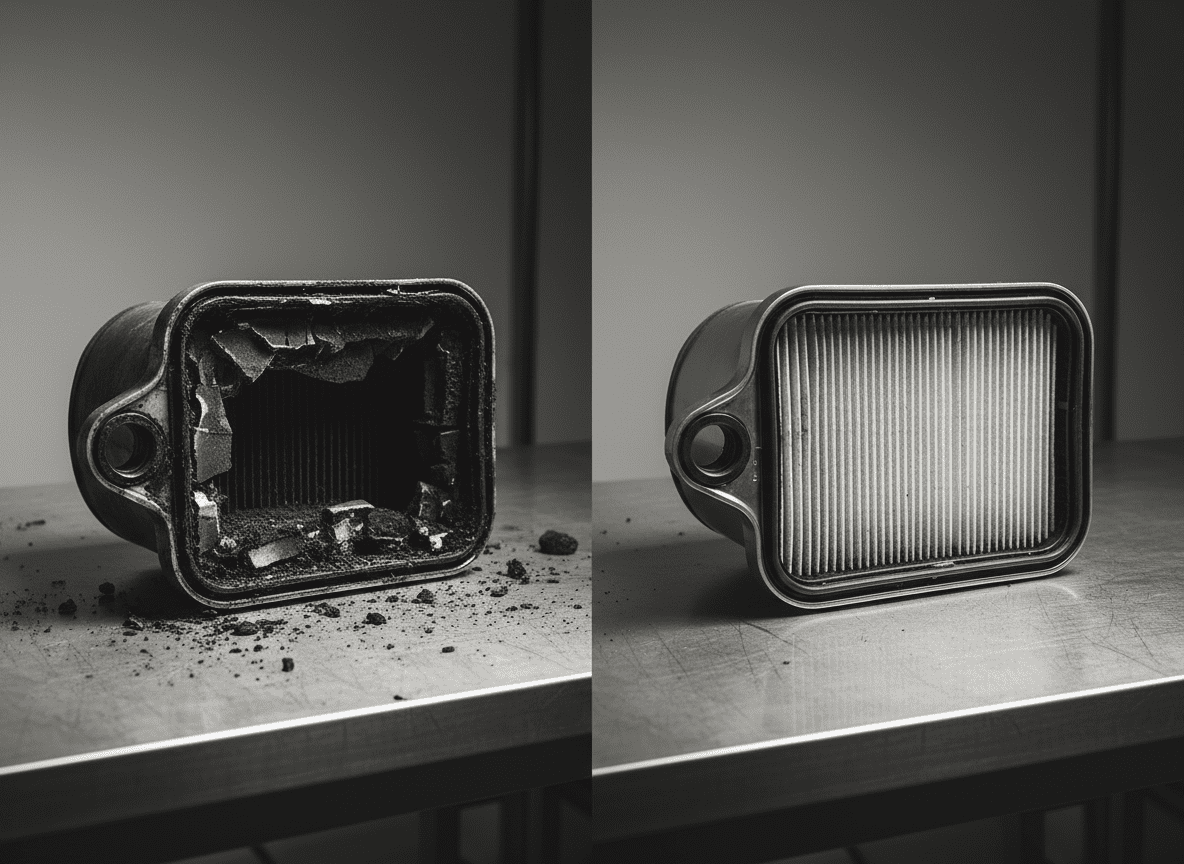
Faulty Injectors and DPF Blockages: How a Worn Injector Loads the Filter
A modern common-rail injector is a precision device. It has to deliver a metered quantity of fuel, atomised into an extremely fine mist, at exactly the right moment in the cycle — often across several separate injection events per stroke. When that stops happening cleanly, combustion becomes incomplete, and incomplete combustion means soot.
The three failure modes we see most
- Poor atomisation. A worn or partially coked nozzle sprays fuel in droplets rather than a mist. Larger droplets burn incompletely and produce visible black smoke plus a heavy soot load.
- Over-delivery. An injector passing more fuel than the ECU has commanded runs that cylinder rich. The excess fuel has nowhere to go but out of the exhaust as particulate.
- Leak-back and dribble. A worn injector that does not seal fully allows fuel past after the injection event has ended. It burns late, at the wrong point in the cycle, producing soot and unburnt hydrocarbons that also foul the filter substrate.
All three are progressive. The vehicle often drives acceptably at first, which is exactly why the fault gets missed — the driver has no reason to suspect the fuel system, and the only visible consequence is the DPF light.
The pattern to watch for: a filter that lasted years before its first clean and then reblocked in weeks has almost certainly developed a new upstream fault in the meantime. A rapidly shortening interval between blockages is the clearest single indicator that the cause is not the filter.
Symptoms That Point at Fuelling, Not the Filter
A blocked DPF and a fuelling fault share several symptoms, which is why the two get confused. There are, however, tells that shift the balance towards the injectors.
| Symptom | Filter restriction alone | Suggests a fuelling fault |
|---|---|---|
| Black smoke under acceleration | Uncommon — the filter traps it | Strong indicator, especially if it persists after a clean |
| Rough or uneven idle | Rare | Common — one cylinder contributing unevenly |
| Diesel knock or a distinct rattle | No | Yes — mistimed or excess injection |
| Hard starting when hot | No | Often, where leak-back is high |
| Reblocking within weeks of a clean | Only if ash-loaded and unresolved | Very likely |
| Rising engine oil level | Only via repeated failed regenerations | Yes — see the section below |
None of these is conclusive on its own. Taken together, though, a vehicle that smokes, rattles at idle and has reblocked twice is not telling you it needs another clean.
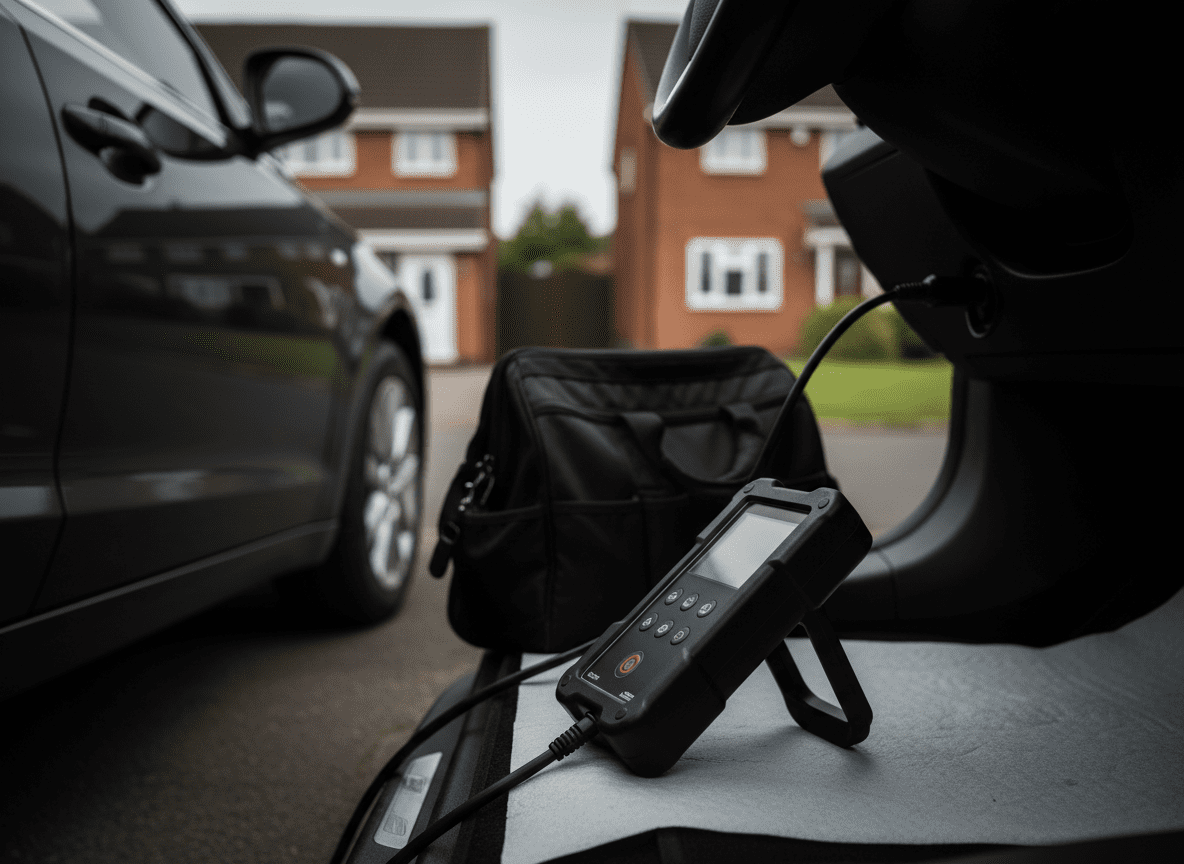
Oil Dilution: The Second-Order Damage
There is a second consequence that makes fuelling faults more urgent than they first appear. During an active regeneration the engine injects additional fuel late in the cycle to raise exhaust temperature. On a healthy engine most of that fuel burns in the exhaust stream as intended. Where injectors are worn, or where regenerations are repeatedly started and interrupted, more of it ends up washing past the bore and into the sump.
The result is a rising oil level and a lubricant progressively diluted with diesel. That is a genuine engine-damage risk, not just an inconvenience, and it is why a rising oil level on a diesel with DPF trouble should never be ignored. We cover the specific fault code that flags it in our guide to P252F and engine oil level too high.
The loop is self-reinforcing: bad fuelling makes soot, soot forces more regenerations, more regenerations dilute the oil, and diluted oil accelerates wear on the components that were marginal to begin with. Breaking that loop means fixing the cause, not repeating the clean.
Other Upstream Causes Worth Ruling Out
Injectors are the most-missed cause in our experience, but they are not the only one. A proper investigation rules out the whole set before recommending anything.
- EGR faults. A stuck or heavily coked EGR valve raises soot production significantly — the interaction is covered in detail in our guide to EGR valve and DPF fault symptoms.
- Turbo issues. A failing turbo passing oil into the exhaust stream contaminates the filter substrate in a way that ordinary cleaning struggles to reverse.
- Boost and air leaks. An intake leak upsets the air-fuel ratio and produces soot even with perfect injectors.
- Incorrect engine oil. Oil outside the manufacturer’s low-SAPS specification leaves more ash behind on every regeneration.
- Sensor faults. A defective differential pressure sensor can trigger warnings and regenerations that the filter never actually needed.
Our broader guide to what causes DPF blockages covers the driving-pattern side of the picture; this article deals with the mechanical faults that sit behind the ones that keep coming back.
What Proper Diagnostics Look For
A generic code reader will tell you there is a DPF fault. It will not tell you why. On a repeat blockage we work through a specific sequence before making any recommendation.
- Full fault code read, including history and freeze-frame data. The stored conditions at the moment of the fault are often more useful than the code itself.
- Live differential pressure and calculated soot load. This establishes how restricted the filter actually is, rather than how restricted the dashboard thinks it is.
- Regeneration history. How many were attempted, how many completed, and how the interval between them has changed.
- Per-cylinder fuelling data. Injector correction values and balance figures show which cylinder, if any, is out of step.
- Injector leak-back testing where the data justifies it. Measuring return volumes identifies a failing injector that live data alone can only hint at.
- Oil level and condition check. Direct evidence of fuel dilution, and a hard stop if it is severe.
This is the difference between a diagnostic and a code read, and it is the reason our assessment is free — we would rather find out that a clean is the wrong answer before you have paid for one. There is more on what that appointment involves in our guide to what a DPF diagnostic check actually covers.
What Happens When Fuelling Is the Root Cause
We are a DPF specialist, not an injector remanufacturer, and we think it matters to be straight about that. If the diagnostic points at the fuel system, we tell you so — and we tell you before we clean anything, not afterwards.
In most cases the sensible order of work is: rectify the fuelling fault first, then clean the filter, then reset the adaptations so the ECU is working from accurate figures. Cleaning first simply means paying twice. Occasionally the restriction is severe enough that the vehicle cannot be driven to a workshop safely, in which case an on-site forced regeneration gets it mobile and the fuelling work follows immediately.
What we will not do is quote for a clean on a vehicle we can see will reblock. It is not a service worth selling, and the customer always finds out.
One thing to avoid entirely: having the filter removed or hollowed out because it keeps blocking. Beyond the emissions consequences, DVSA guidance is unambiguous — if a DPF or diesel catalytic converter fitted as standard has been removed, the vehicle fails the MOT regardless of the metered smoke result. It converts a repairable fault into an unusable vehicle.
DPF Blocked Again? Find Out Why Before You Clean It Again
Free mobile diagnostics across the West Midlands. We read live fuelling data, soot load and regeneration history — and we tell you honestly if cleaning is not the answer.
Frequently Asked Questions
Can a faulty injector cause a blocked DPF?
Yes, and it is one of the most common underlying causes of repeat blockages. A worn, leaking or poorly atomising injector burns fuel incompletely, which raises soot output well beyond what the filter was designed to absorb. The filter blocks faster than the regeneration cycle can clear it.
Why has my DPF blocked again so soon after cleaning?
Because the cause was not addressed. Cleaning removes the accumulated soot and ash but changes nothing upstream. If a fuelling fault, EGR problem, air leak or turbo issue is producing excess soot, the filter simply fills again. A shortening interval between blockages is the strongest sign of an unresolved root cause.
How do I know if it is the injectors or the DPF?
Live data settles it. Injector correction and balance figures show whether a cylinder is fuelling incorrectly, and leak-back testing measures how much fuel an injector is returning rather than delivering. Symptoms alone are ambiguous, which is why a code read on its own is not enough to make the call.
Do you replace injectors as well as clean DPFs?
Our specialism is DPF diagnostics, cleaning and forced regeneration. Where the diagnostic identifies a fuelling fault we tell you clearly what has been found and what needs doing, so the repair can be carried out before the filter work rather than after it. We would rather turn down a job than sell a clean that will not last.
Will an additive fix a DPF that keeps blocking?
Not where a mechanical fault is causing it. Additives are designed to help a marginal regeneration complete; they do nothing about an injector that is over-fuelling a cylinder. If a filter keeps blocking despite treatment, that is a reason to diagnose the engine, not to try a stronger bottle.