
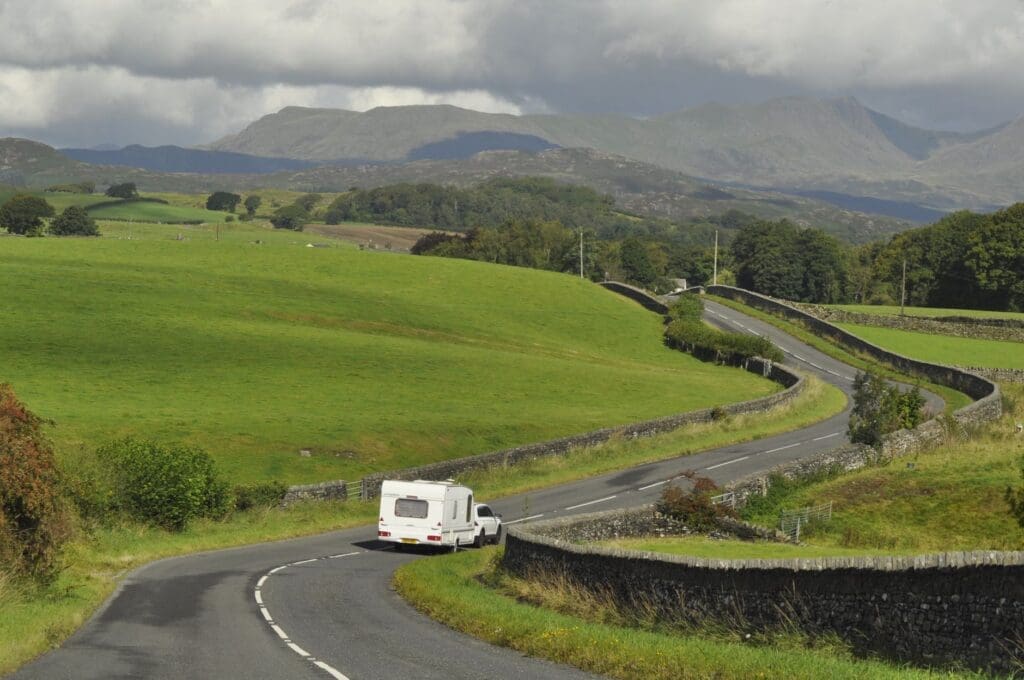
Almost every customer who rings us about towing DPF problems arrives with the same theory: the caravan did it. It is an understandable conclusion — the DPF light appeared on the way back from a fortnight in Wales, so the trailer must be the culprit. In practice it is very rarely the tow itself. Towing puts sustained load through a diesel engine, and sustained load is one of the better things that can happen to a particulate filter.
What causes the problem is the pattern of use that surrounds the towing season. A tow car that spends nine months doing school runs and supermarket trips, sits on a drive over winter, then gets hitched to a two-tonne caravan for a bank holiday, has been through three completely different duty cycles in a year. The filter has to cope with all of them, and the failure usually shows up at the point of highest demand.
Short answer: Towing itself rarely blocks a DPF — sustained high engine load usually helps a filter regenerate. The problems appear either side of the tow: months of storage, short shakedown runs, and low-speed manoeuvring on site. Those cycles interrupt regeneration, and the soot carried into the next journey is what eventually triggers the warning light.
In This Guide
- Does Towing Actually Block a DPF?
- Towing DPF Problems: The Four Points in a Towing Year
- Horseboxes, Plant Trailers and the Low-Speed Problem
- Weights, Ratings and Why the Engine Never Gets a Break
- What a Blocking DPF Looks Like on a Tow Car
- What We Check When a Tow Car Comes In
- Protecting the Filter Around a Towing Season
- FAQs
Does Towing Actually Block a DPF?
No — not on its own. To clear itself, a particulate filter needs heat. The Government’s own guidance describes the process plainly: regeneration burns the trapped soot to gas at a very high temperature, leaving only a small residue behind. Anything that raises exhaust gas temperature and holds it there for a sustained period is helping that happen.
Towing does exactly that. A loaded trailer forces the engine to work harder at motorway speed, exhaust temperatures rise, and passive regeneration runs more readily than it does in stop-start traffic. On a well-maintained tow car, a long haul down the M5 with a caravan on the back is closer to a treatment than a cause.
The same guidance also makes the flip side clear: regeneration that is not carried out properly leads to a build-up of soot that affects performance and ends in expensive repairs. That is the real mechanism, and towing season is simply where an interrupted regeneration history finally gets exposed.

Towing DPF Problems: The Four Points in a Towing Year Where Filters Block
When we look back through the live data on a tow car that has just gone into limp mode, the story is almost always in one of four places.
1. The long lay-up
A caravan tow car, horsebox 4×4 or motorhome base vehicle often stands for months. Occasional short runs to keep the battery alive are the worst possible use — the engine never reaches operating temperature, so soot goes in and nothing comes out. By spring the filter can be carrying a substantial load before the season has even started.
2. The shakedown trip
The first outing of the year is usually short and local: a night away, a rally 20 miles down the road, a trial run to check the hitch and the electrics. Load is high, distance is low, and any regeneration the ECU tries to start gets cut off when the engine is switched off at the site gate.
3. The interrupted regeneration on the return leg
This is the classic. Three hours of motorway, the ECU decides conditions are finally right and commands an active regeneration — and the driver pulls into the services, or reaches home, twelve minutes into a cycle that needed twenty. That aborted cycle leaves the filter hotter, fuller and no cleaner. Repeat it a few times across a summer and the warning light is inevitable.
The habit worth building: if the car is still pulling strongly and the fan is running hard as you come off the motorway, give it another ten minutes at a steady speed before you park. It costs almost nothing and it is the single most useful thing a towing driver can do for the filter.
4. The end-of-season storage
Putting the vehicle away with a partially loaded filter is how a problem carries into next year. Nothing burns off over winter; the ash stays exactly where it is.
Horseboxes, Plant Trailers and the Low-Speed Problem
Not all towing is motorway towing, and the low-speed end of it is much harder on a filter than the caravan run people worry about.
Horsebox work in particular is a difficult duty cycle. Loading at a yard, a few miles of lanes, an hour of idling at a venue, then a few miles home. The engine is working under load but never sustains the temperature needed for a clean regeneration. Plant and tipper trailers on short site-to-site hops behave the same way.
Boat trailers add another wrinkle — slipway work means long periods of idling and reversing at very low road speed, exactly the conditions in which soot accumulates fastest. If your towing is mostly this kind of work rather than long-distance touring, the filter deserves a check before it starts complaining, not after.
It is the same underlying mechanism we describe in our guide to why short journeys cause DPF problems, but with the added complication of a heavy load producing more soot per mile.
Weights, Ratings and Why the Engine Never Gets a Break
Towing rules in Great Britain are more permissive than many drivers realise. If you got your licence from 1 January 1997, you can tow a trailer weighing up to 3,500kg MAM on a category BE entitlement. Licences issued before that date generally allow a combined weight of up to 8,250kg.
The practical consequence is that a lot of mid-size diesel SUVs and pickups are now being asked to move loads that sit near the top of their capability, all summer, on the original filter. That is not a fault — the vehicles are rated for it — but it does mean the engine is producing soot at a much higher rate than it does in normal use, and the regeneration schedule the manufacturer designed around average driving no longer matches reality.
| Towing pattern | Effect on the DPF | What we usually see |
|---|---|---|
| Long-distance caravan touring | Generally positive — sustained high exhaust temperature | Problems only where regens are cut short at journey’s end |
| Short local tows, heavily loaded | Negative — high soot output, no regeneration window | Rapid soot loading, repeat warning lights |
| Horsebox / show circuit | Negative — load plus extended idling | Failed active regens logged in the ECU |
| Seasonal use with winter lay-up | Negative — soot carried across a dormant period | Light appears on the first big trip of the year |
| Plant and tipper site work | Negative — low speed, high load, frequent stops | Ash loading alongside soot on higher-mileage vehicles |
What a Blocking DPF Looks Like on a Tow Car
The symptoms are the usual ones, but towing changes when you notice them. A partially blocked filter that feels fine unladen can feel dramatically wrong with two tonnes behind it, because the restriction matters far more when the engine is being asked for everything it has.
- Noticeable loss of pulling power on gradients that were fine last season
- DPF warning light appearing part-way through a long towing run
- The cooling fan running hard for several minutes after you park
- A strong hot smell after a motorway leg — often an active regeneration in progress
- Fuel consumption creeping up beyond what the extra weight explains
- Limp mode, usually at the worst possible moment — a hill, a slip road, a busy site entrance
If the light has already appeared, our guide to what to do when the DPF warning light comes on covers the sensible next steps before the fault escalates.
What We Check When a Tow Car Comes In
Our view is that the diagnostic matters more on a towing vehicle than on almost anything else, because the driving pattern is so uneven. Cleaning a filter without understanding the cycle that filled it just resets the clock.
On a free diagnostic check we read the live differential pressure across the filter, the calculated soot and ash loads, and the regeneration history stored in the ECU. That history is the useful part. A vehicle showing a long run of started-but-incomplete regenerations is telling you something very specific about how it is being used, and that changes the advice we give.
We also look at whether ash rather than soot is the dominant load. Soot burns off; ash does not. On a high-mileage tow vehicle the balance between the two decides whether on-vehicle forced regeneration will hold, or whether a deeper clean is the honest recommendation. We would rather tell you that at the diagnostic stage than after you have paid for the wrong service.
Protecting the Filter Around a Towing Season
None of this needs to be complicated. A handful of habits covers most of it.
- Give the last ten minutes back. Finish a towing run at a steady speed rather than cutting it short in traffic, and let any regeneration in progress complete.
- Do a proper run before the first tow, not a short one. Twenty minutes at sustained speed unladen is worth more than three trips round the block.
- Get a check before the season, not after the light. A soot reading in April is information; a limp mode in August is a recovery bill.
- Do not store it dirty. If the filter is loaded going into winter, deal with it before the vehicle stands.
- Take the warning light seriously the first time. On a towing vehicle the gap between a warning and a genuine restriction is shorter than it is on a commuter car.
Once a clean has been carried out, the DPF aftercare advice we give every customer applies just as much to a tow car — arguably more, because the duty cycle is what caused the issue in the first place.
On cost: the diagnostic check is free, and cleaning costs a fraction of what a replacement filter and fitting would. We do not publish a flat price because the work genuinely varies with the vehicle, the access and what the live data shows — anything we discuss before we have seen the readings would be a guess rather than a quote. You get a confirmed figure after the diagnostic and before any work starts.
Towing Season Coming Up? Get the Filter Checked First
Free mobile diagnostics anywhere across the West Midlands — at home, at the yard or at the storage site. We read the live soot, ash and regeneration data before recommending anything.
Frequently Asked Questions
Does towing a caravan help clean the DPF?
Usually, yes. Towing raises engine load and exhaust temperature, which is what passive regeneration needs. A long motorway tow is one of the better duty cycles a diesel can have. The exception is when the journey ends mid-regeneration — that leaves the filter no cleaner than it started.
Can towing damage a diesel particulate filter?
Towing does not damage the filter directly. What causes damage is running a heavily loaded engine with a filter that is already restricted — back pressure rises, exhaust temperatures climb, and on a badly blocked system that can eventually affect the turbo. The towing does not create the blockage; it exposes it.
Why did my DPF light come on during a towing trip?
Almost always because the filter was already carrying a load from the driving that preceded the trip, and the extra soot produced under tow pushed it past the threshold. It is worth reading the stored data rather than assuming the trip caused it — the regeneration history usually shows the problem building over the previous months.
Should I do a regeneration run before towing a caravan?
A sustained unladen run of twenty minutes or more before the first tow of the season is sensible, particularly after a winter lay-up. If the vehicle has been standing and doing only short local trips, a diagnostic check is a better use of the time — a driving cycle will not clear a filter that is already heavily loaded.
Do you come out to storage sites and yards?
Yes. We are a mobile service covering the West Midlands, and a large share of our towing-vehicle work is done at caravan storage sites, equestrian yards and farm premises rather than at a home address. Tell us where the vehicle is parked and we will confirm coverage.


