Can a Blocked DPF Damage Your Turbo? How Back Pressure Affects Engine Health
A blocked DPF doesn’t just affect the filter itself. Sustained driving with a heavily loaded filter raises exhaust back pressure, and that pressure has knock-on effects on the turbocharger, injectors, EGR system and engine oil. This guide explains how the damage develops, what to watch for, and when professional intervention prevents far more expensive repairs.
In this guide
DPF light on alongside power loss?
Free diagnostics check both the filter and connected systems before any work begins. Mobile service across the West Midlands.
What back pressure is and why it matters
Back pressure is the resistance the engine has to overcome to push exhaust gas out through the exhaust system. Some back pressure is normal — every exhaust system creates some — and engines are designed to operate within a normal range.
The DPF is one of the components that contributes to back pressure, and its contribution is supposed to vary in a controlled way. A clean filter creates low back pressure; a soot-loaded filter creates more; a regenerated filter returns to lower pressure again. The ECU watches this through the differential pressure sensor and uses the readings to manage regeneration cycles.
Problems begin when the filter loading climbs past the level the ECU is willing to manage on its own and regeneration can’t clear it. Back pressure stays elevated for an extended period, and that’s when secondary effects start to appear in components that depend on the exhaust system behaving normally.
How a blocked DPF damages the turbo
Modern turbocharged diesels are tuned to specific exhaust flow conditions. The turbocharger uses exhaust gas energy to spin a compressor that increases air intake pressure. When back pressure rises beyond design conditions, the turbo’s operating environment changes in ways that accelerate wear and, in some cases, cause failure.
Reduced exhaust flow
A heavily loaded DPF restricts how quickly exhaust gas can leave the cylinders. With less flow available, the turbine wheel has less energy to convert into compression. Boost falls, and the engine performance feels sluggish — particularly under load. The car may struggle on hills, take longer to overtake, or feel noticeably underpowered even outside limp mode.
Variable geometry vane wear
Most modern diesel turbos use variable geometry — small movable vanes that adjust the exhaust gas angle hitting the turbine wheel. These vanes are exposed directly to the exhaust stream, and they’re the most common turbo component to suffer from sustained back pressure.
When back pressure is consistently high, the vanes are pushed into operating positions outside their normal range. Over time they can become sticky, then partially seized, then fully stuck. A turbo with sticking vanes commonly produces reduced boost, fluctuating boost, or hard starts when cold — symptoms that build gradually rather than appearing all at once.
Bearing wear
Turbo bearings rely on a continuous oil supply at correct pressure. If back pressure has affected oil flow indirectly — for example, through oil dilution, which we’ll come to next — bearing wear accelerates. The first sign is often a low-frequency whine from the turbo, followed by visible blue smoke under acceleration as oil starts to bypass worn seals.
Why turbo replacement is so much pricier than DPF cleaning: A new variable geometry turbo for a typical UK diesel can run from several hundred to well over a thousand pounds before fitting labour. Resolving a blocked DPF early — through cleaning or forced regeneration — costs a small fraction of that and prevents the chain of damage from starting.
The oil dilution problem
Oil dilution is one of the most damaging consequences of a blocked DPF, and it’s the one most likely to lead to engine repairs rather than just exhaust component repairs.
Here’s how it develops. When the ECU triggers active regeneration, it injects a small post-combustion fuel charge to raise exhaust temperatures. On a healthy DPF, this fuel burns and exits as exhaust gas. On a blocked filter, regeneration often fails to complete — and some of that injected fuel doesn’t burn fully. Instead, it washes down the cylinder walls past the piston rings and ends up in the engine oil sump.
Once fuel mixes with engine oil, several things go wrong:
- Oil viscosity drops, reducing its ability to lubricate engine bearings and turbo components
- The oil’s protective additive package becomes diluted and degrades faster
- Oil level rises above the dipstick maximum mark — the opposite of what most owners expect
- Engine wear accelerates, particularly on the camshaft and crankshaft bearings
If your dipstick reading is high: A rising oil level on a diesel is a signal of fuel dilution. If you’ve also been seeing DPF warnings, the connection is direct. Don’t continue driving long distances on diluted oil — change the oil and resolve the underlying DPF issue together. Continuing to drive risks engine bearing damage that will far exceed the cost of acting now.
EGR, injector and combustion effects
Back pressure affects more than just the turbo and oil. The exhaust gas recirculation (EGR) system, injectors, and combustion process itself all adapt — sometimes badly — to sustained high back pressure conditions.
EGR valve and cooler issues
When back pressure is high, more soot-laden exhaust gas can be pushed back through the EGR system into the intake manifold. This accelerates carbon build-up on the EGR valve, the intake ports, and the cooler matrix. A heavily carboned EGR system reduces airflow into the cylinders, which makes combustion less efficient and produces yet more soot — a cycle that worsens DPF loading further.
Injector spray pattern
Injectors are calibrated to spray a specific pattern into a specific combustion environment. When back pressure changes that environment, combustion completeness drops. Unburned fuel exits with the exhaust, contributing both to oil dilution (during regeneration) and to additional soot loading the DPF must handle.
Higher exhaust temperatures during regen attempts
If the ECU keeps trying to force regeneration through a blocked filter, exhaust temperatures climb higher than normal as the system tries harder to burn off the soot. Sustained high temperatures stress the turbo, the exhaust manifold, and any sensors mounted on the exhaust line — including the DPF differential pressure sensor itself, which may then start giving inaccurate readings, compounding the original problem.
Damage timeline: how fast does it develop?
Secondary damage from a blocked DPF doesn’t happen overnight. The timeline below is approximate — actual progression depends on driving style, engine condition, and how aggressively the ECU keeps attempting regeneration — but it gives a useful sense of when the risk transitions from “manageable” to “likely to cause additional repairs”.
| Stage | What’s happening | Typical risk level |
|---|---|---|
| DPF light on, no power loss | Soot loading raised, regen attempts increasing | Low — usually resolves with intervention now |
| Increased fuel use, occasional regen smell | Active regen running often but not always completing | Low to moderate — early oil dilution may be starting |
| Power feels sluggish, regen smell frequent | Back pressure consistently elevated, partial completion at best | Moderate — turbo and oil at increasing risk |
| Limp mode, oil level rising | Filter heavily loaded, fuel washing into oil | High — turbo and engine wear actively accelerating |
| Complete blockage, undriveable | Filter fully restricted, possible substrate damage | Severe — turbo damage likely, replacement risk for both DPF and turbo |
The pattern matters more than exact mileage. A filter that has reached limp mode and is producing rising oil levels is telling you the secondary damage timeline has already begun. Acting at this stage usually still prevents the worst outcomes; waiting another month often does not.
When to act before secondary damage starts
The practical answer to “when should I act” is “as soon as the warning light appears”, but in real life most owners come to us further along the curve than that. Whatever stage you’re at, the right next step is the same — get a diagnostic readout that shows what’s actually happening rather than guessing from symptoms alone.
From there, the options depend on what we find:
- If the filter is moderately loaded with no signs of secondary damage, forced DPF regeneration usually clears it and prevents the chain reaction from continuing.
- If loading is severe or regen has failed before, mobile DPF cleaning at your location restores the filter to clean condition without needing to recover the car to a workshop.
- If the car is in limp mode and stranded, an emergency DPF call-out handles the situation without recovery costs.
- If oil dilution is suspected, an oil and filter change as part of the work — combined with a check for fuelling or injector issues that may have contributed — limits the damage that has already occurred.
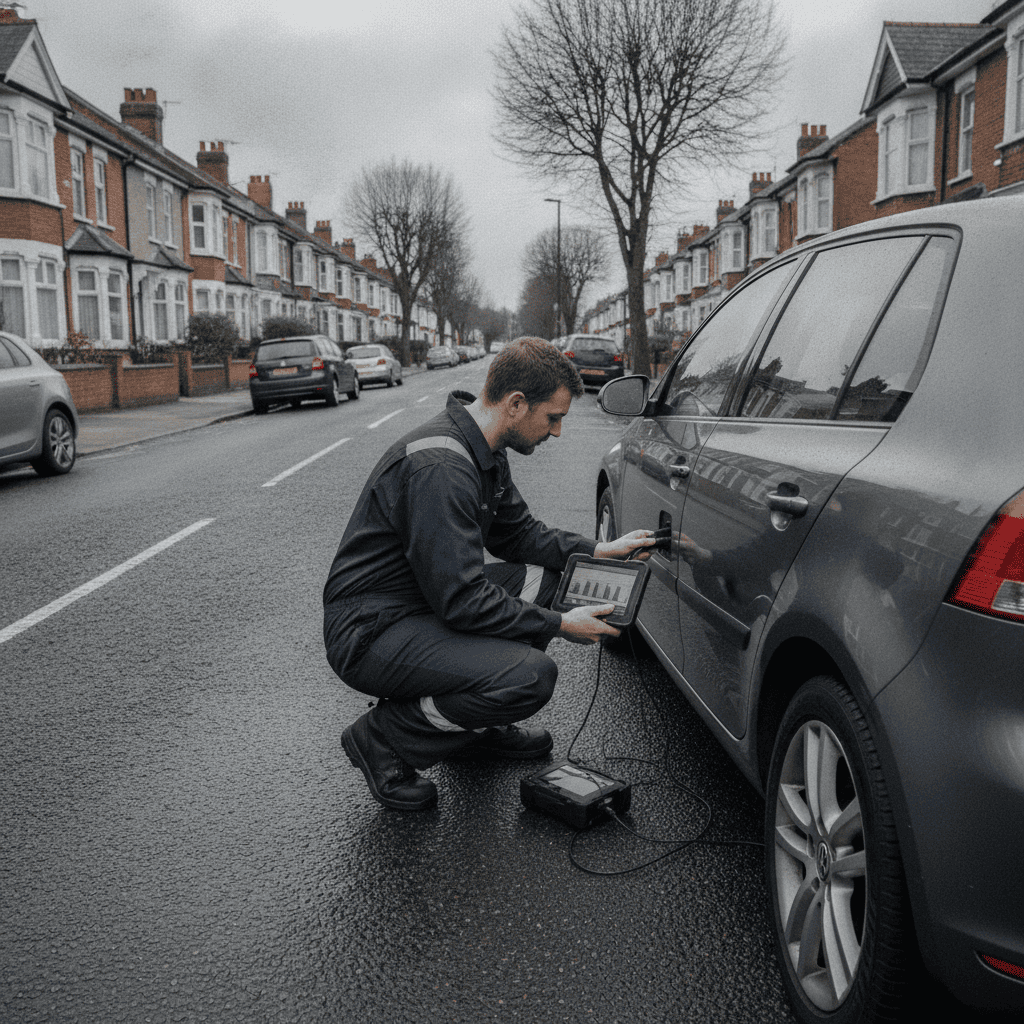
In every case, the starting point is free DPF diagnostics — at your home, work, or roadside. Knowing what you’re dealing with avoids paying for the wrong fix and keeps the cost of recovery low.
Don’t let a DPF problem become a turbo problem
Free DPF diagnostics across Birmingham, Wolverhampton, Walsall and the wider West Midlands. Mobile service brings us to you.
Frequently asked questions
Can a blocked DPF cause turbo failure?
Yes — usually indirectly, through prolonged high back pressure affecting variable geometry vanes and through oil dilution affecting turbo bearings. Direct, sudden turbo failure from DPF blockage alone is rare; gradual deterioration over weeks or months is far more common and just as expensive in the end.
How can I tell if my oil is diluted with fuel?
The two clearest signs are a rising oil level (above the dipstick maximum mark) and a strong diesel smell on the dipstick when warm. If both are present, dilution is highly likely. Driving on dilute oil at this point risks accelerated bearing wear, so an oil change combined with addressing the DPF is the practical response.
Will fixing the DPF reverse the damage to the turbo?
Resolving the DPF removes the cause and prevents further damage, but any wear that has already happened to the turbo doesn’t reverse itself. The earlier you intervene, the more likely it is that no replacement parts are needed beyond the DPF service itself.
How long can I drive in limp mode safely?
Short distances to get the car somewhere it can be assessed are usually fine. Sustained driving in limp mode — particularly at motorway speeds where the engine is straining against restricted output — adds wear quickly. If you’re in limp mode, treat it as urgent rather than something that can wait a couple of weeks.
Is the cost of treating a blocked DPF worth it compared to replacement?
Almost always yes. Professional DPF cleaning typically costs a fraction of replacement on most diesels. The exception is when the substrate has been damaged by prolonged blockage or runaway regeneration — but that’s exactly the outcome that early action avoids. The earlier the diagnosis, the cheaper the fix.